



ARTICLES
Neil Peart’s opinion on Stewart Copeland and The Police

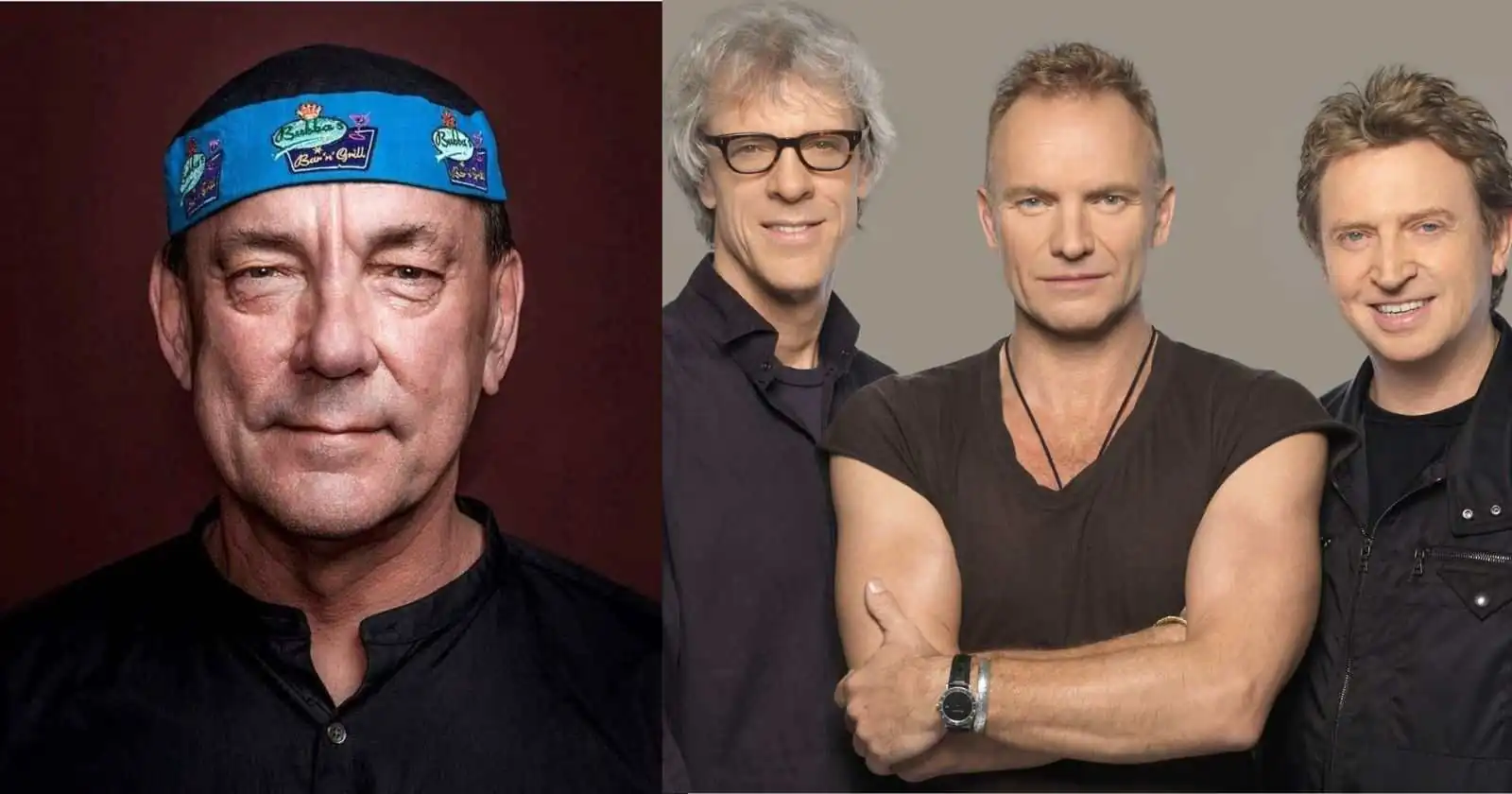
Considered one of the greatest drummers of all time, Neil Peart was a force of nature. Few of his peers could do justice to the incredible drum parts he created or to the remarkable lyrics he wrote for Rush. Although Rush’s music was often complex and heavily influenced by Progressive Rock, Peart had an incredibly broad musical taste and admired many bands that fans might never have expected. Over the decades, he shared his thoughts on many artists, including The Police and their drummer, Stewart Copeland.
What was Neil Peart’s opinion on Stewart Copeland and The Police
Neil Peart was a big fan of The Police and became a good friend of Stewart Copeland, who is a drummer he admired a lot. In fact, he said that he and Rush were influenced by their music. “I listen (to drummers) for what they have. There’s a lot of different kinds of drumming that turn me on. It could be a really simple thing, and I don’t really think my style reflects my taste. There are a lot of drummers that I like who play nothing the way I do. There’s a band called The Police and their drummer plays with simplicity, but with such gusto. It’s great. He just has a new approach,” he told Modern Drummer already in 1980.
In his book Traveling Music, Neil mentioned the band as an influence on Rush. He also recalled being surprised to hear that The Police were actually booed in their own country when their music was played over the sound system before the Canadian band’s shows. “By that time Punk and new wave had themselves, inevitably, progressed, as they were bound to do (even if a band started out genuinely inept, they were likely to improve and grow). By 1980, the leading edge of pop music had metamorphosed into ambitious, creative bands like Ultravox and the Police. All that flux crept into Rush‘s music. ‘You are what you eat,’ or what you hear.’ For me, the same motivation applied that had moved me at the beginning. I loved to listen to music, so I wanted to play it.”
he continued:
“(…) On those first ShowTapes, in the late 70s, I was mixing in a lot of the socalled “new wave” music of the time. Talking Heads, Ultravox, Japan, Joe Jackson, and the Police. We were touring in Britain once around that time, and our sound engineer told me that when a song by the Police came over the P.A., the English audience actually booed. Hard to believe, but so it was,” he said.
According to him, in an interview with Canadian Musician in 1994, people thought you couldn’t like both bands. “If you liked The Police, you couldn’t like Rush and if you liked Rush, you couldn’t like The Police. It really shocked me. Here was another band who, at the time, was very interesting with good musicians and doing good stuff. There was no reason for a young musician not to like them. I know when we started introducing those kind of same influences into our music, a lot of our fans were appalled! It was like, ‘Oh no, Rush is putting reggae into their songs! Not them, too!!'”
“It was like we betrayed them. We betrayed the past. And that’s how it was, because those kind of people wanted to hear Styx and Foreigner and Boston and the FM of the seventies continue on. Suddenly, we were daring to break away and join up with these infidels. And to sign up with the rebels and say, ‘Hey, we think they’re doing something good. We’re going with them. Bye!’ he said.
What Stewart Copeland said about being a friend of Neil Peart during his final years
“Neil knew it was coming, in fact, it took about two years longer than expected. At one point he says ‘Dude, I am past my sell-by date by a year and then he carried on for another year. So he saw it coming, he made his peace, he was all adjusted, his close friends were with him, it was beautiful. It was really a first-class ticket, he saw his train coming.”
“(…) Neil knew he was ‘The Professor’, all he had to do was play a show and there would be 80.000 people air drumming every lick, same with Charlie Watts and Ginger Baker. (…) When he first passed I got a call from his roadie that afternoon. That night, the band, family, crew gathered in a restaurant in Venice Beach and I had seen it coming. I felt that it was a full ride, full life, well lived and I was kind of upbeat about it. I just hang out with him occasionally.”
He continued:
“But the people who he’s in their lives everyday, his wife, his crew, Alex and Geddy, they were just blown away. Even though they also saw it coming. But there was this hole in their life suddenly. Cut to two weeks later, in the memorial, is sunk in. The Professor is gone, no more hang at the Bubba cave, you know. It really started to get me at the memorial. His family and closer people had kind of begun to deal with it, we were able to smile again at the memory of his life,” Stewart Copeland said in an interview with John Poveromo (Transcribed by Rock and Roll Garage).
Curiously, Neil Peart became a fan of The Police and an admirer of Stewart Copeland’s playing long before the American drummer became familiar with Rush’s music. As Copeland recalled in an interview with Preston & Steve, it was a little embarrassing for him to discover that Neil Peart was a fan because he didn’t know much about Rush at the time.
Stewart Copeland said:
“It was actually a little embarrassing (when I found out he was a fan). Because the only thing I knew about Rush was that we played at a festival that they were headlining way back. We were way down the bill, we were playing at still broad daylight when we played our set. But on the main stage, there was this huge, huge drum set shrouded in a giant… You know, wow, that’s got to be the (greatest) drum set ever. And of course, the talk backstage was that for Neil to get into it, he needs a trapdoor (laughs).”
“(I was saying to myself) ‘One day I will get there with a monster drum that I need a trapdoor to get into’. So I actually didn’t know that much about Rush. Until (years later) I was introduced to him by Les Claypool of Primus. He brought him over and we got along really great, all seven feet tall of him. We became really good buddies. I got my sacred grove over here, my studio where my buddies come over and jam.”
Stewart Copeland continued:
“(He was) a regular guest here, he gets on drums and that’s it. Neil’s on drums, which means I get to play guitar. (Neil Peart) came over a lot, he had his place, the Bubba cave, like a car museum. He didn’t have any drums in there. I got every known form of musical instrument here, but there it’s all about his cars. That’s where he did his writing. We would go have a big Mexican lunch over there occasionally,” he said (Transcribed by Rock and Roll Garage). Both Copeland and Peart were born in 1952, but the Canadian musician began his professional career earlier, in 1968, while the American drummer didn’t become a professional musician until 1974.