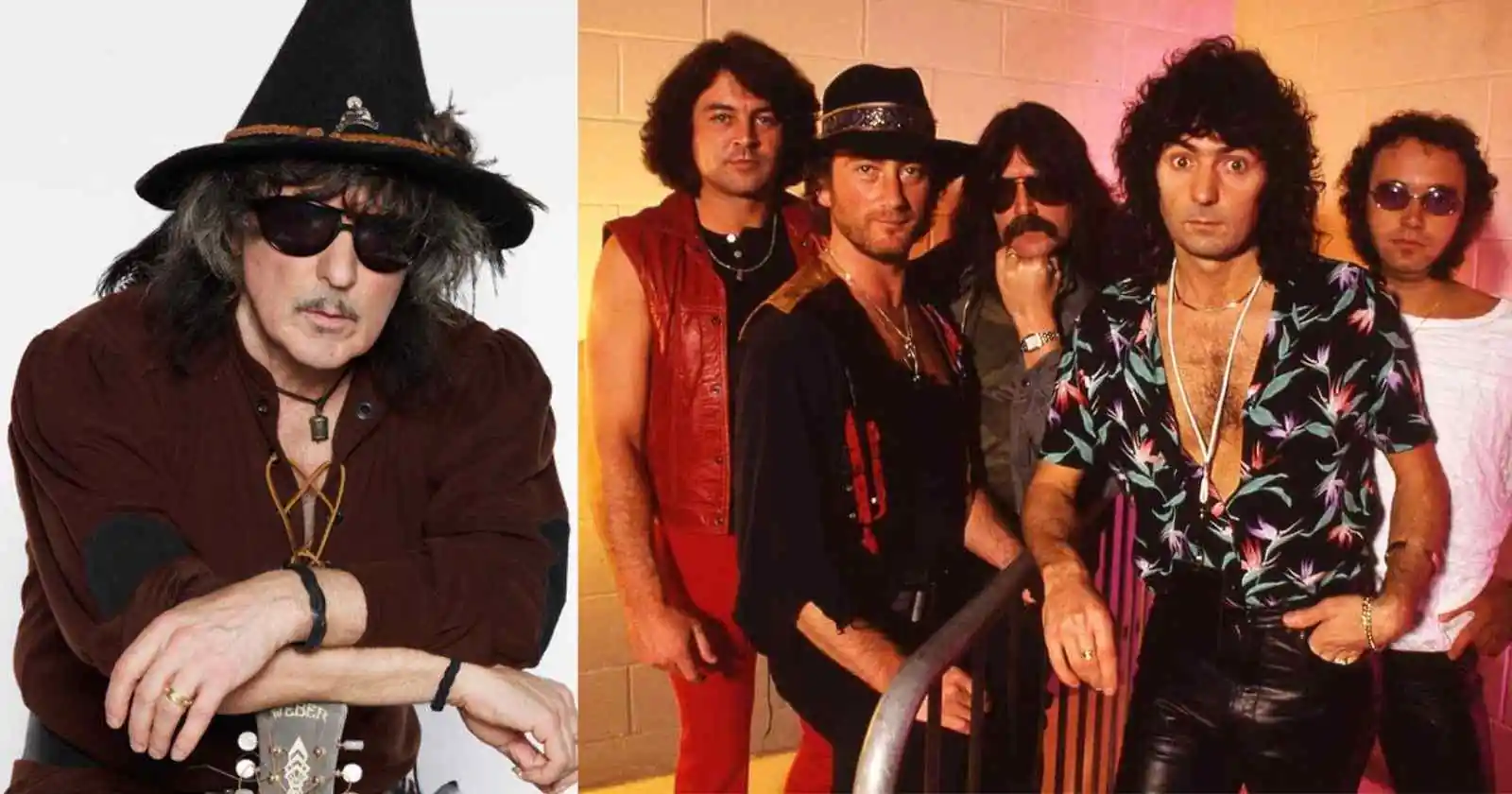
One of the key elements of Deep Purple’s success, guitarist Ritchie Blackmore created some of the most influential guitar riffs and solos in the history of Rock and Roll. He played on all their most successful albums including some he later admitted he didn’t like.
Over the years Blackmore spoke about many records from the band’s discography and once revealed which two he thought were bad.
The 2 Deep Purple albums Ritchie Blackmore said were bad
“House of The Blue Light” (1987)
The first album Ritchie Blackmore told Record Collector in 1998 that it was awful was “House of Blue Light” (1987), the second studio album made by the band’s classic line-up during the reunion. “I thought Perfect Strangers was very good. But The House Of Blue Light, I thought that was terrible. I’ve noticed it seems to be like a good record then a bad record then a good record. It seems to be in that order. I’m not one for sitting around listening to my own music. Because I tend to cringe and think that I could have done better.”
“I also suffer from red light syndrome quite a lot. I’m not sure whether that’s my nature or whether that was because of session work, where you couldn’t make a mistake. I tend to narrow my thinking when the red light goes on to record. Instead of just relaxing and playing and emoting, I think of time being wasted so I won’t take a chance on something. Consequently, when I hear it back, I think, ‘Why the hell did I play it so safe on that piece of music when I could have really opened up?’ Well, it’s because of not wanting to make a mistake,” he told The Quietus in 2017.
“The House of Blue Light” recording process was long and difficult. The relationship between the members was not very good at the time. Some of the best-known songs from that album are “Bad Attitude, “Call of the Wild” and “Hard Lovin’ Woman”. It peaked at number 1 in the charts of countries like Finland, Germany and Sweden,
“The Battle Rages On” (1993)
The second record is “The Battle Rages on”, released in 1993, which became the final Ritchie Blackmore album with the band. “The Battle Rages On” – although that was shaping up to be a good LP without the vocals. If you just heard the backing tracks, they sound really good.”
“(We wrote) two tracks: ‘Stroke Of Midnight’ and ‘Lonely For You’ (With Joe Lynn Turner – They were not featured on the record). Joe sang them and it was brilliant. I thought, ‘We’ve got to do this, and if we take on Gillan we’re going to tape this song and do it exactly the same’.”
“(So) I spoke to management and asked if Gillan realized he had to sing that one song exactly right. Because that’s one of the conditions of him rejoining. I knew he was going to be a headache, and they said he did. I saw him in the studio and he didn’t know anything about it. That didn’t help matters but that wasn’t Gillan’s fault, it was the management,” Ritchie Blackmore told Record Collector.
Two years after The House of the Blue Light, in 1989, vocalist Ian Gillan decided to leave Deep Purple and was replaced by former Rainbow singer Joe Lynn Turner. With the new frontman, the group recorded Slaves and Masters in 1990, and he remained in the band until 1992. In 1993, Gillan returned and recorded “The Battle Rages On”, but his relationship with Ritchie Blackmore didn’t improve.
Why Ritchie Blackmore left Deep Purple after that album
Ultimately, the guitarist left the band for good in the middle of the tour promoting the record. He recalled in an interview with National Guitar Museum in 1996 why he decided to leave the band back then. “Okay, here’s what happened in Deep Purple. During the last tour (The Battle Rages On), I wrote them a letter saying I can’t hack this circus. The band’s great. I love them, but I can’t take the singer. I knew I wouldn’t after I rejoined, but they were after me to join for months.”
“Then I said, “You know what? I’ll try it and see what happens.” And after about six weeks on the road, I really couldn’t handle it. Ian Gillan’s perceptions of music and mine were worlds apart. I like to hear melodies and have singers remember the words. I wrote a letter to all of them saying I have to leave, but I’ll stay for six weeks until you find another guitar player,” Ritchie Blackmore said.
The guitarist was a co-founder of Deep Purple, being part of the band from 1968 to 1975 and from 1984 to 1993. Blackmore was part of all their most influential and famous releases. Leading Rainbow he made many classic records like: “Rising” (1976), “Long Live Rock N’ Roll” (1978) and “Difficult To Cure” (1981). During the past decades he is focused on Blackmore’s Night, band formed with his wife Candice Night.
I'm a Brazilian journalist who always loved Classic Rock and Heavy Metal music. That passion inspired me to create Rock and Roll Garage over 6 years ago.
Music has always been a part of my life, helping me through tough times and being a support to celebrate the good ones. When I became a journalist, I knew I wanted to write about my passions.
After graduating in journalism from the Pontifical Catholic University of Minas Gerais, I pursued a postgraduate degree in digital communication at the same institution. The studies and experience in the field helped me improve the website and always bring the best of classic rock to the world!
MTB: 0021377/MG