
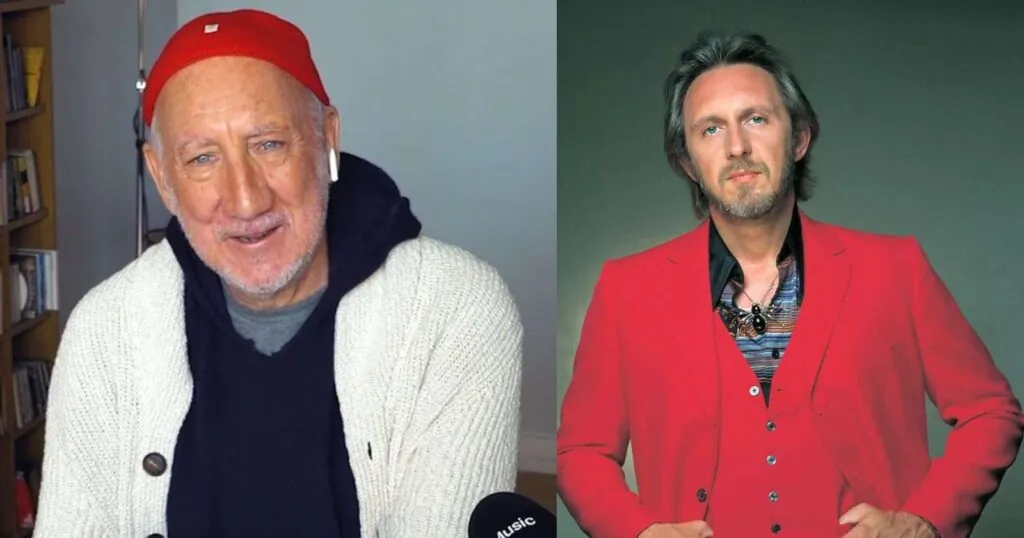
The bassist John Entwistle was one of the most important elements of The Who’s sound and alongside Pete Townshend, Keith Moon and Roger Daltrey created some of the most important albums in the history of Rock and Roll. Although he is mainly remembered as an incredible bass player, in Townshend’s opinion, he was much more than that as a musician.
What is Pete Townshend’s opinion on John Entwistle
To Pete Townshend, John was a real musician right from the beginning of the band, something he didn’t consider himself to be. In his opinion, the late bassist had a transcendental quality that could be compared to Jimi Hendrix. “I think a lot of people don’t understand that The Who sound (in the first years) was with John’s open harmonic sound, he was playing like a Bach organ, it was rich with harmonics. Huge, massive rich sound which would start the head going, kind of like a psychedelic thing, like a shaman thing.”
“The thing that I often talk about Jimi Hendrix, you go and see Jimi Hendrix play and you see what he’s playing and you think ‘I’m not hearing what he is playing. I’m hearing more!’ That’s what happened with John. That didn’t happen in the studio because you put it all on tape. But in a room you would start to hear things coming out of what John was playing. It’s all to do with the way harmonics function in large rooms. It’s not a particularly happy period for Who fans when (we) went out in 1989 with a 14 piece band, but I listened to the recordings that we did of ‘Love Reign O’er Me’ and ‘I Can See for Miles’, which has a six-part backing vocals.”
He continued:
“You can’t do it with three voices, there are six parts in contradistinction, that’s what makes such a great record. They are great recordings but John is not wanging away with open harmonics. He’s playing the bass, he sounds like Pino Palladino. He knew what to do, he was a fucking musician. The thing was, when there was just the three of us as a band. Just two instruments, Pete and John, the only thing with string was Pete and John, he had to do what he did.”
“Otherwise we would have needed a band. For my music we certainly, I don’t know for his writing, but for my writing, God, we would have needed 20 musicians to get that at a low level. What happened at the 89 tour was that I said to Roger: ‘I’ll come out and tour with you guys, but I don’t want the level to go up 100db.’ He said: ‘No problem, we’ll just make him turn down’. I said: ‘No, it will be a problem, because if you make John turn down you will lose the harmonics.”
Pete Townshend continued:
“We have to add the harmonics with other instruments. People didn’t like it, but that was the only way that we could do it. It was the only way that we could get the harmonic richness, was to add trumpets, brass, a second guitar, acoustic guitar, two keyboards, backing vocals, people banging gongs. Because that’s what John used to replicate! All of that stuff! He’d play that bass and you’d hear all of this stuff. Don’t take this too far, I don’t want to turn this into an absurd overdone eulogy. But I’ve worked with this guy from the very, very beginning,” Pete Townshend said in the documentary “An Ox’s Tale” (Transcribed by Rock and Roll Garage).
Why John Entwistle changed bass guitar according to Pete
Entwistle influenced countless generations of bass players over the decades and is considered one of the greatest bassists of all time. To Townshend, he was not only one of the best but also someone who changed the instrument. In his view, he approached his playing in a totally different way that nobody had ever done before.
“He made his own first bass with his own hands, a great overlength bass, with very, very, very long strings. His passion at the time was… He wanted to be a lead guitarist and could have been a lead guitarist, of course, but decided to differ. He knew I could play guitar and we were in a band where Roger (Daltrey) was the lead guitarist. Roger was not a bad player at all. He wasn’t a great player but he was a good lead guitar player and was charismatic as a guitar player. And we were in his band (Roger’s), so John had to differ and pick up something else. So he picked up the bass, started to (play) the bass.”
“You very quickly got the feeling that ‘Ok, he’s playing the bass but he’s not really playing the bass (laughs). You know, this is something else’. What he realized was that he had the power to change the fucking instrument! He could change the instrument! You don’t change the trumpet, you can buy all the different versions that there already are. But you know, as he went along to do and he had the money, he just had every sort that was possible.”
Pete Townshend continued:
“But the trumpet had evolved over hundreds of years as the guitar had but the bass guitar was relatively new. It was invented probably by Fender or somebody (It was invented by Paul Tutmarc in the USA , Leo Fender, or some of those guys probably decided to invent the bass and mass produced by Fender in 1951).”
“It (was) a brand new thing and he started to change it. He started to play it differently, hold it differently, he had this completely different wrist technique to everybody else. The bass players were still (pretty much playing like the) upright bass (but in the horizontal), the most unattractive position. So John dropped down, started to (play in his way) and (would look and say) ‘This guy looks cool playing the bass’. There were no cool looking bass players, it was a contradiction in terms.”
“The girls just wanted to (be) with singers and drummers. The singer because he was gorgeous and the drummer because he would last longer (laughs). Nobody would ever look at a bass player, ever! Suddenly you realize actually there would be a lot of girls in the audience at our early pub gigs looking at John, finding him attractive, charismatic.
He continued:
But he changed the instrument. This is more about changing the way you play it, hold it, express it and what it’s for. You know, opening the sound up. He was quite capable of playing basic bass as you can hear right through the ‘Tommy’ album. The bass playing is very much what you call workman like. But when he really, really wanted to go for, (like) in The Who’s first album on that track ‘The Ox’, the sound is explosive, the bass is wiry, (was a) Danelectro.”
“On that short scale he played it like a guitar. My point is that he believed that he could express himself through his situation, he had power over his situation. Where he learned that was through the guitar, so I think being on stage with a guitar, with a big amplifier, became his voice. Not just the voice of his musicianship, the voice of his nature. It was who he was, so you didn’t get the complete John until you got there,” Pete Townshend said in an interview for the documentary “An Ox’s Tale” (Transcribed by Rock and Roll Garage).
Pete Townshend said John Entwistle was brilliant and could emulate an orchestra
“You know, I think you have to look at what John was made of. In a sense he was a boy abandoned, not completely. But his mom and dad broke up when he was a little boy. His dad went back to Wales, which is where he came from, I think. John and his dad got on very well but they didn’t see a lot of each other. So he’s brought up by a stepfather and music begins with him with his sort of congregational Church connection. He used to play the bugle in the Boys Brigade. So he learned to read music in a primitive way and when he and I first got together, he decided for some reason to play the bass.”
“Not because he wouldn’t be able to play the guitar, he could have easily done that. But because everybody was playing the guitar in 1959, everybody was playing the guitar. You know, Lonnie Donegan had just got a lot of Skiffle hits, so had Nancy Whiskey, The Shadows had released ‘Apache’. You know, everybody was trying to play the guitar. In America you had Elvis, Eddie Cochran, Everly Brothers. It was all guitar, guitar, guitar, bloody guitar. I think he just decided to play the bass because ultimately I think his main passion was brass instruments, you know.”
He continued:
“When we got to record Quadrophenia, he produced a whole stack of brass instruments. (John) could actually emulate an orchestra and did so on that record. He could play the brass euphonium, he could cornet, French horn, he could play anything. He was a brilliant, brilliant musician. So there I was on my guitar and it was him and me, this is before we even met Roger. (I was) smashing up amplifiers if they buzzed at me in the wrong way. I couldn’t really play, I don’t know if I can really play that well today. (These days) I still throw myself into it with eye shades on hoping that I will hit a decent bum note.”
“But right from the beginning John was a musician, that was his thing. He was involved in music and he was involved in it as a craft. So he practiced and he practiced long and hard meanwhile when I should have been practicing the guitar, because I was the lead guitarist in a big Rock band, I was writing songs, that’s what I did.”
Pete continued:
“So I would tap myself away and the only guitar playing I would do would be if I happened to play guitar on a demo, you know. John practiced, practiced and practiced, I think in a sense excelled to such an extent that he left himself behind. His fingers were extraordinary, he invented the double tapping technique that people use today. Eddie Van Halen extended it on the electric guitar, but John was doing it years before anybody else,” Pete Townshend said in an interview with Billy Sloan in 2024 (Transcribed by Rock and Roll Garage).
John was a member of The Who from 1964 until his death in 2002 at the age of 57. During his career he also released five solo studio albums, one with The Rock and one as the John Entwistle Band, his final one, in 2000.