ARTICLES
4 musicians Neil Young said can really play guitar

Although Neil Young is remembered first and foremost as one of the greatest songwriters in rock history, the guitar has always been his closest musical companion and the instrument through which he created some of his finest work. While he has never been considered a traditional “guitar hero,” Young has always paid close attention to great players and remained interested in discovering new talent.
When answering a fan question, Young once named four guitarists who, in his opinion, “can really play.” Rock and Roll Garage selected what he has said about each of them over the years.
4 musicians Neil Young said can really play guitar
Van Halen
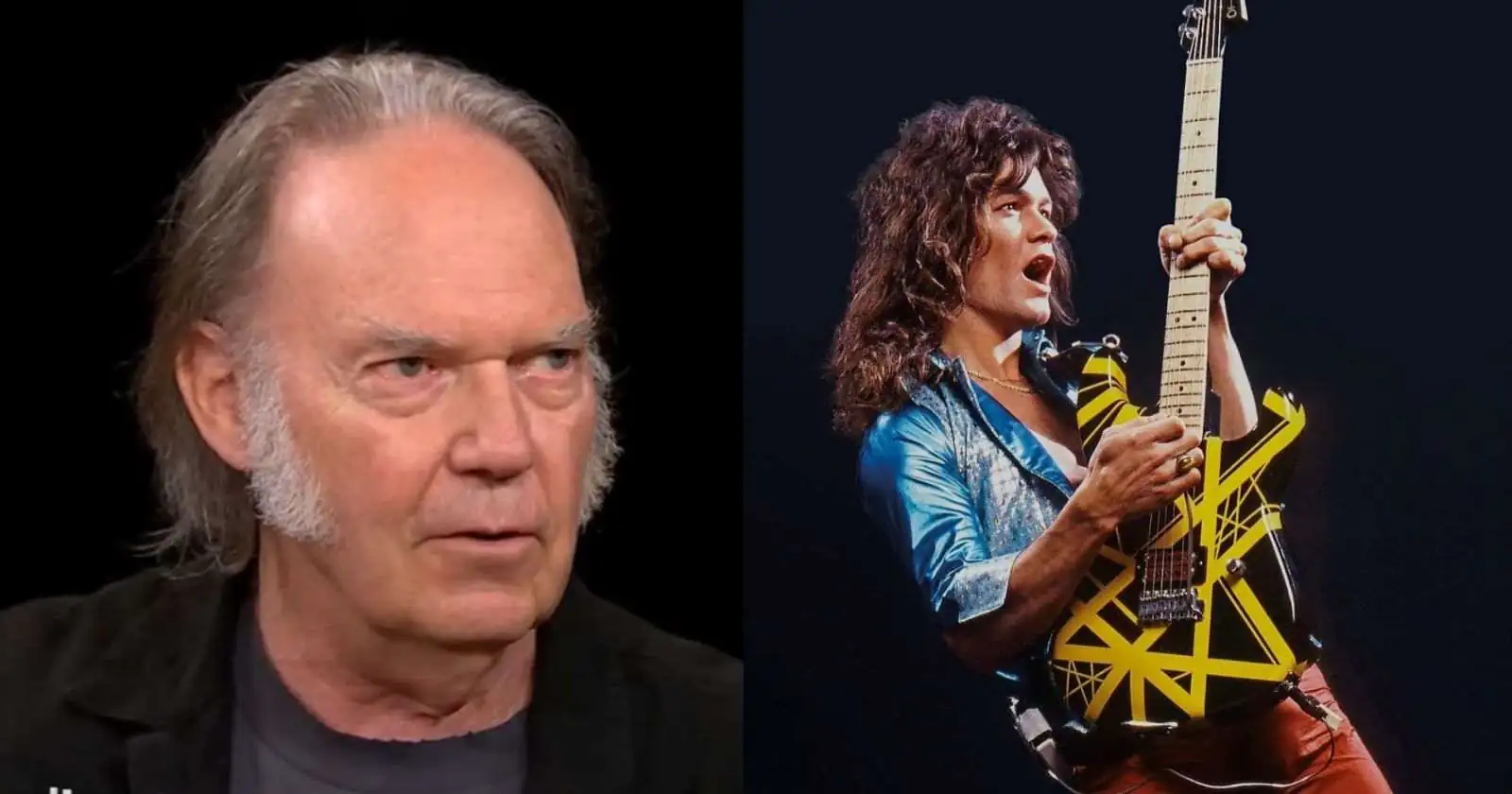
The first one is Eddie Van Halen, whom Neil described as a genius. He praised the guitarist while discussing how different his playing style was compared to faster players like Ed. “First off, nobody cares if you know how to play scal es. Nobody gives a shit if you have good technique or not. It’s whether you have feelings that you want to express with music, that’s what counts, really. When you are able to express yourself and feel good, then you know why you’re playing. The technical aspect is absolute hogwash as far as I’m concerned. It bores me to tears. I can’t play fast. I don’t even know my scales and I know that most of the notes I play aren’t where I play them. They’re simply not there.”
“So you can play any note you like. I think about it on another level, I don’t care about that sort of shit. On the other hand, I appreciate really great guitarists, and I’m very impressed by those metal groups with their scale guitarists. When I see that, I go ‘Holy shit, that’s really something’. Satriani and Eddie Van Halen are guitar geniuses. They are incredible musicians, at an amazing level. But it doesn’t really grab me. One note will do.”
He continued:
“(Like Cinnamon Girl) That’s right: two chords. The same note on two chords. The vibrato makes each note sound different. People say it’s a one-note solo, but in my mind, every one of those notes is different. The further you go into it, the more you can hear the differences,” Neil Young said in an interview with Guitare & Claviers Magazine (France) in 1992.
Interestingly, Eddie was a fan of Neil’s “Cinnamon Girl” and said it featured one of his favorite guitar solos. “One of my favourite solos is in ‘Cinnamon Girl’ by Neil Young. It’s a one-note solo and it just fits the song. Anyone else would have gone woraaagh and it wouldn’t have made any sense. If I’ve changed over the years, it’s that I’ve got more in tune with the song.”
“You’ve gotta decide, are you making music for people or are you doing it for yourself? Anyone who says that they’re not making music for people can kiss my ass. I dunno, maybe they should just sit home in their closets and make music. Why bother making records and trying to sell them if you’re trying to make music for yourself?”
He continued:
“These guys who claim, ‘I’m an artist and I don’t care if I make records or not…’ Well, why even bother making them? I want to sell records; I want people to enjoy what I’m doing as much as I do. And if that means I’m selling out, then I’m selling out…” Eddie Van Halen said in an interview with Guitar World in 1993 that the guitar solo in “Cinnamon Girl” was an influence for him.
Eddie had the chance to meet and play with Neil Young when he was part of the Bridge School Benefit concert in 1993, which was organized by the Canadian musician. One year later Neil was part of the charity golf tournament organized by the guitar player.
Jimi Hendrix
The second guitarist mentioned by Neil is Jimi Hendrix, who he inducted into the Rock and Roll Hall of Fame in 1992. That ceremony had the former members of his band Mitch Mitchell (Drums) and Noel Redding (Bass). Although Neil and Jimi were not close friends, they had the chance to meet each other a couple of times.
“Hendrix was the best at being able to do his expression with his guitar. I’d say out of the 60s as far as someone taking the guitar to another place, Hendrix was number one. There was no other guitar player that came near to Hendrix in the way he handled it playing Rock and Roll as trio. A three man band, guitar, bass and drums.”
Neil Young continued:
“He was so unique, he had his own place. It was the Jimi Hendrix Experience, of all the trios, there was nothing like the Jimi Hendrix Experience. The way they all played together, the bass player and the drummer, it was all three of them together that made that sound. Jimi wasn’t the same when he played with the other bands, it wasn’t the same. It was what happened when he played with those guys that made him free enough to express himself.”
“To go to those places that he went with his echoplex and his whammy bar, the distortion and the multi-amp approach that he used, that vibrates the guitar to the point where you stand in front of it. It’s not that loud for you because it’s behind you and people in front of it get their heads blown off. So you just move the guitar a little bit and let the sound come out of the amp, hit the back of the guitar and vibrate it and don’t dampen with your body and suddenly the guitar just takes off like hell,” Neil Young told Musicians Hall of Fame in 2005 (Transcribed by Rock and Roll Garage). Neil said many times that in his opinion, there will be no one like Hendrix again.
Hank Marvin
The third guitarist mentioned by Young is Hank Marvin, the only non-American on this list. The British musician first achieved fame as a member of The Shadows, which was originally the backing band of acclaimed singer Cliff Richard from 1958 to 1968. During that period, the group also found success on their own with influential instrumental tracks such as “Wonderful Land,” “Apache,” and “Summer Holiday,” which became a major influence, especially for aspiring British guitarists.
“I started off writing instrumentals (When I was 19). Words came much later. My idol at the time was Hank B. Marvin, Cliff Richard’s guitar player in the Shadows. He was the hero of all the guitar players around Winnipeg at the time. Randy Bachman too; he was around then, playing the same circuit. He had a great sound. Used to use a tape repeat,” Neil Young said in an interview with Rolling Stone in 1975.
Marvin also was a big inspiration for names like Tony Iommi (Black Sabbath), David Gilmour (Pink Floyd), Mark Knopfler (Dire Straits) and Ritchie Blackmore (Deep Purple and Rainbow). Until 1990, The Shadows released 21 studio albums. After that they reunited a few times in 2004, 2005, 2008, 2010 and 2015.
JJ Cale
The final guitar mentioned by Neil is the late J.J. Cale who also was a huge inspiration for names like Eric Clapton and Mark Knopfler. “(J.J. Cale was) one of the finest, most masterful guitar players. You can hear his influences on Clapton, Dire Straits’ Knopfler. It’s like they have obviously learned a lot from J.J. and hardly anybody knows who J.J is. (He) did enough songs so that musicians and people who are in the music really know who he is, but somebody may listen to (a song and don’t know he wrote it).”
He continued:
“But if you’re really into music then you know who J.J. is but the normal guy in the street will know who Eric Clapton is but won’t know who J.J. Cale is. Will know who Mark Knopfler is but won’t know J.J. He is a defining influence, he really has got the touch,” Neil Young told Musicians Hall of Fame in 2005 (Transcribed by Rock and Roll Garage).
In Young’s opinion, although people call Clapton a guitar God, he can’t play like J.J. Cale. “What is it about J. J. Cale’s playing? I mean, you could say Eric Clapton’s the guitar god, but what the fuck does that mean? I mean he can’t play like J.J. J.J.’s the one who played all that shit first. Most of the songs and the riffs—the way he plays the fucking guitar is so … great. I think we’d play great together. There’s no doubt, if it was just the two of us, it’d be somethin’ special,” he said.
Besides collaborating with Eric Clapton, who famously covered his songs “Cocaine” and “After Midnight,” he was also the writer of “Call Me the Breeze,” which was famously covered by Lynyrd Skynyrd. He passed away in 2013 at the age of 74.