


ARTICLES
Bob Dylan’s opinion on The Who

Although Bob Dylan is nowadays frequently labeled as a Folk Rock musician, he originally played acoustic guitar, embodying the traditional style of that genre. It was mainly his songwriting that made him stand out and in the early 1960s become one of the most influential artists in the world. Across the Atlantic in the United Kingdom, young musicians were being inspired by Blues and Rock, but they were also impacted by Dylan’s songwriting, which showed them that they could write their own songs about any subject.
The Who’s main songwriter and guitarist Pete Townshend was one of them. Over the decades, Dylan spoke about some of the bands he influenced, sharing his opinion on them, including The Who.
What is Bob Dylan’s opinion on The Who
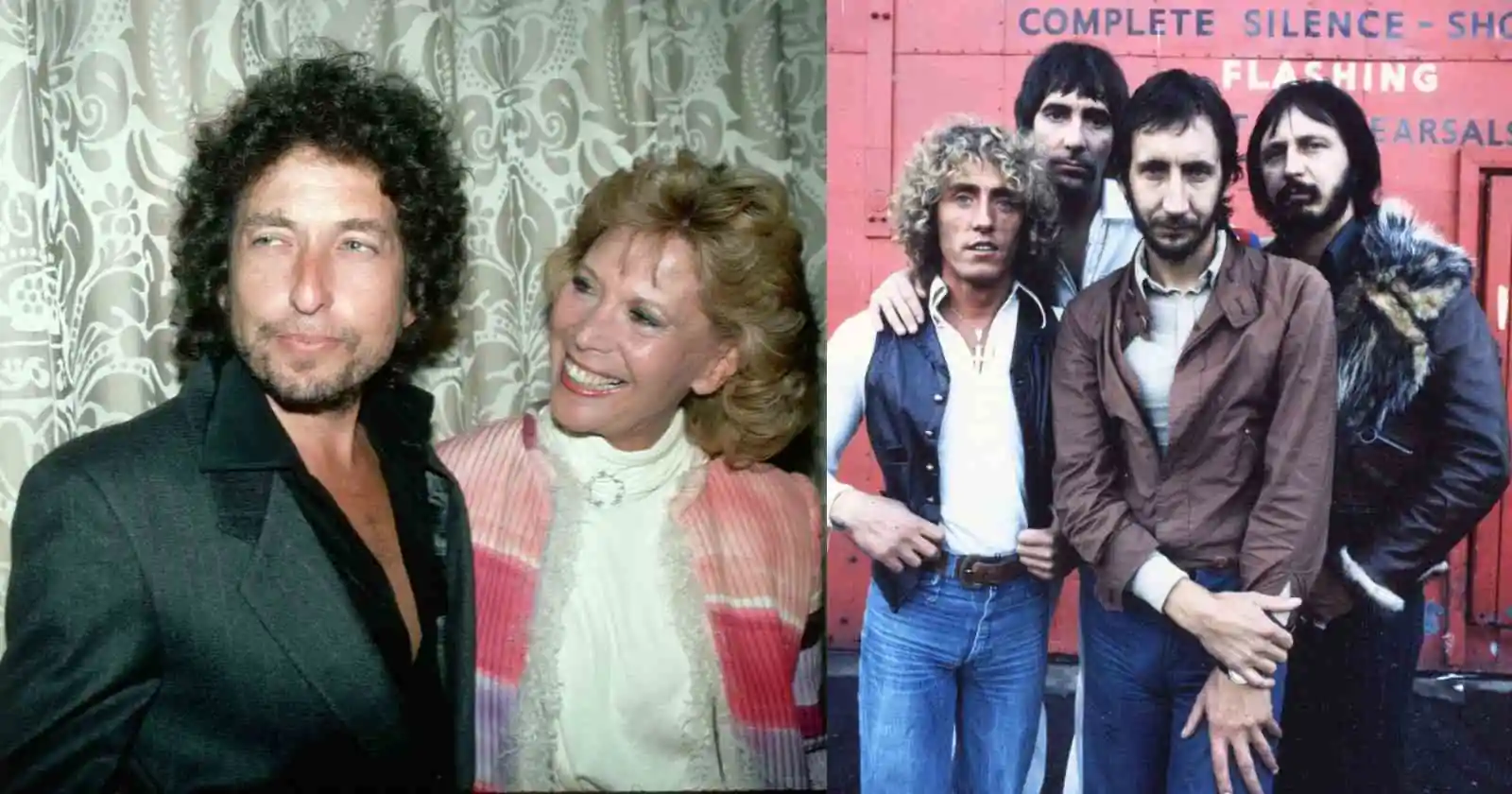
Bob Dylan likes The Who and in 2025 he even wished Pete Townshend a happy birthday in a funny way, saying: “Happy birthday, Pete. Who’s the new boss? Is he like the old boss? Have you met him yet? Say hello to Roger,’ Dylan said, making a reference to the lyrics of the famous Who track “Won’t Get Fooled Again”.
In his book “The Philosophy of Modern Song” (2022), Dylan commented on songs he believed were important for the evolution of music. One of them was The Who’s “My Generation”, the group’s first hit song (1965). “Like a lot of boomers, Pete seems to have a chip on his shoulder in this song. But he’s not totally confident, he’s somewhat back on his heels. There’s a certain defensiveness. He knows people put him down just because he gets around. Perhaps he feels like he will never measure up or he knows they resent his generation’s newly abundant leisure time.”
Bob continues saying that the songwriter, Pete, wished they would just disappear or as it’s said in the song “fade away”. It is a reason why he says “I hope I die before I get old” because he doesn’t want to be replaced like he is replacing the older generation.
“Pete can’t even point the finger himself, he depends on his mouthpiece Roger to hurl the invective. That fear is perhaps the most honest thing about the song. We all rail at the previous generation but somehow know it’s only a matter of time until we will become them ourselves.”
He continued:
“Pete would probably be the first to tell you. He has a front-row seat for the history of his generation. He could read the picket signs against hatred and war. Well, that certainly ended that, thank you for your service. Each generation seems to have the arrogance of ignorance, opting to throw out what has gone before instead of building on the past.”
“They have no use for someone like Pete offering the wisdom of his experience, telling them what he has learned on the similar paths he has trod. And if he’d had the audacity to do so, there’s every chance that person would have looked up at Pete and told him that he couldn’t see him, he couldn’t hear him. And that gave Pete another idea,” Bob Dylan said.
During his analysis, Dylan described the song as one that “does no favors for anyone and casts doubt on everything”. For him, the lyrics describe the hard feelings the older generation has toward ‘My Generation’. He points out that just the presence of young people “repels them”. The folk rock artist also explained that every generation chooses what it wants to keep and what it wants to reject from the previous generation.
Bob Dylan inspired Pete Townshend to write “My Generation”
Curiously, according to Pete Townshend, Bob Dylan, who is one of his heroes, was an inspiration when writing “My Generation” back in the 1960s. “Dylan definitely created a new style of writing. Dylan was the one who I think got the message across to The Beatles. (That) was that you can write songs about subjects other than ‘falling in love’.”
“When I started to work on ‘My Generation’, I started working on a Mose Allison and Bob Dylan hybrid of a talking Folk song. But you can take any song of his and find something in it that is pertinent to today,” he said in an interview with Rolling Stone in 2011 (Transcribed by Rock and Roll Garage).
The American songwriter has always been a huge inspiration for Townshend and said he was his hero. But also had some aspects he didn’t like about the artist. “Well, there was Bob Dylan. When I was a kid. Well, not a kid, but younger and listening to Dylan. I couldn’t wait for the day when somebody would get to him and do that in-depth interview. (It would be) where everybody would find out what really was in the back of his head.”
He continued:
“And when I discovered that there was nothing there at all. Nothing, I must say I was incredibly disappointed. From that day onward, he ceased to be my hero. He remained somebody who wrote music that I loved. I still love the earlier stuff for the pure nostalgia of remembering how stimulating he was. But he wasn’t quite the gladiator I had expected. You can’t deny, though, that Dylan’s music marked a new dimension in rock ‘n’ roll. He opened the door for rock to say bigger and better things,” Pete Townshend told Cameron Crowe in 1974.
Townshend had the chance to cover Dylan’s son “Corrina Corrina”, from “The Freewhelin’ Bob Dylan” album released in 1963. His version was part of the charity compilation record “Chimes of Freedom”. The album consisted had covers of Dylan’s songs and the profit was donated to the human rights organization Amnesty International.
The question Pete Townshend asked Bob Dylan
“About in 1996 I got a chance to ask Bob Dylan a question. You know, if you get to meet this guy, don’t ever ask him a question (laughs). Although he talks a lot more today than he did back in 1996, he really has opened up a lot. (…) Anyway, this was back in 1996. I said: ‘Listen, I’ve always wanted to ask you what is a Folk singer. Because you know, when I grew up, the guitar was the instrument of skiffle.”
“(…) When I first heard Bob Dylan I realized that from then on, I think I heard him after I’d heard The Beatles, from then on when I heard his early work I realized that you could write a song about anything, absolutely anything. (So Bob’s answer was) ‘Pete, it’s a man with a good memory’,” Pete Townshend said during a live event in 2010 (Transcribed by Rock and Roll Garage).