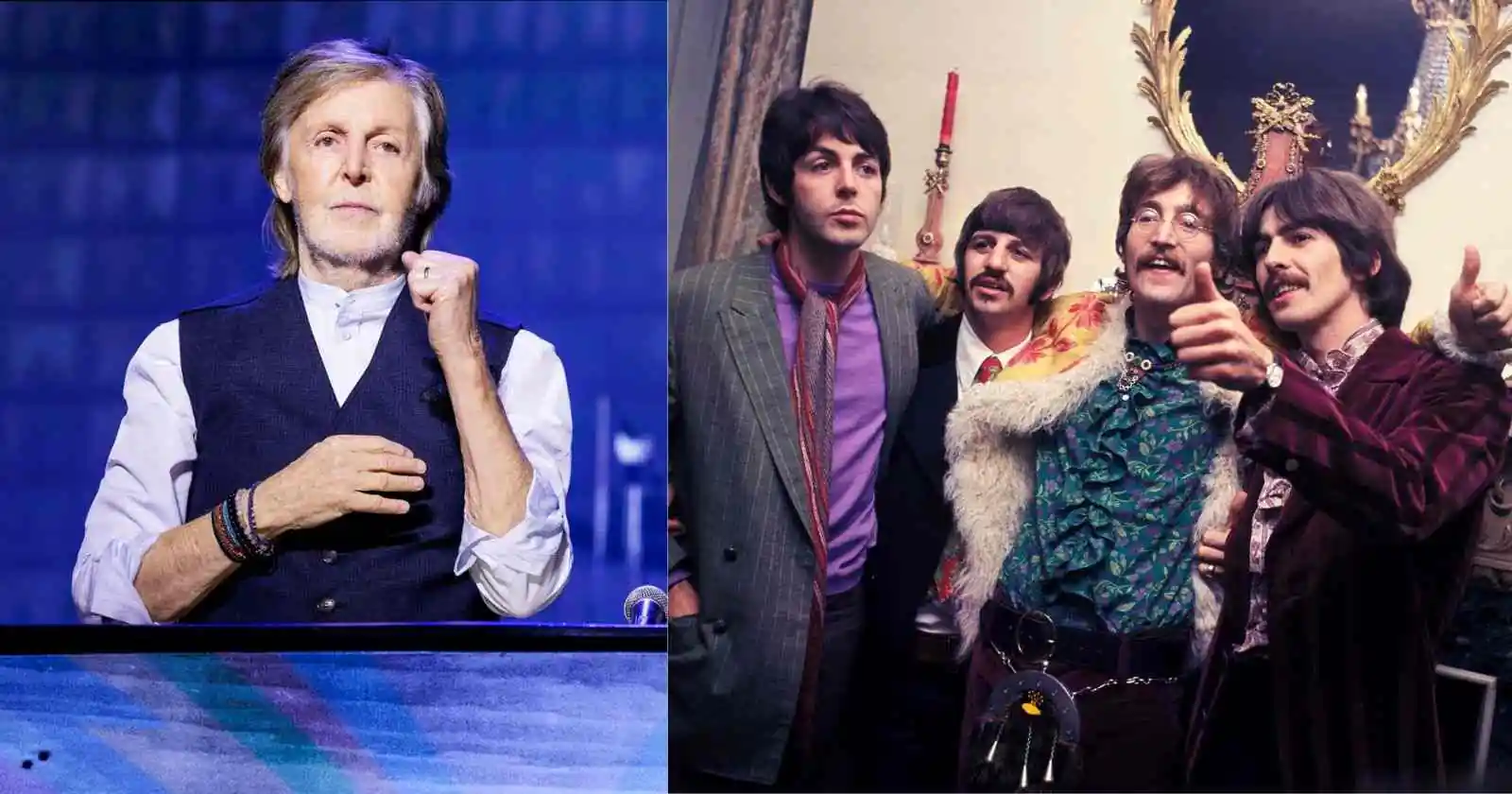
Formed by Paul McCartney, George Harrison, Ringo Starr and John Lennon, The Beatles changed the course of music and were copied by countless bands over the past decades. Their compositions were unique and showed that songwriting had many new possibilities to be explored. However, as everything is inspired by something that came before, Paul McCartney once revealed three songs that The Beatles “stole” from other artists.
3 songs Paul McCartney said The Beatles stole from other artists
“I Saw Her Standing There” (Chuck Berry “I’m Talking About You”)
“In the early Beatles John and I used to steal, man. You know that quote: A bad artist borrows from others, a good artist steals. We used to call it nicking. ‘I Saw Her Standing There’ is ‘Talking About You’ by Chuck Berry,” Paul McCartney said in an interview with Musician magazine in 1990.
Chuck Berry was a huge influence to The Beatles and McCartney always saw him as a poet. “He was a huge influence on us. We copied a lot from his guitar style, he was just a huge influence. I always saw him as a poet, you know. His lyrics to me are like American poetry, they capture that sort of high school sort of stuff, the cars, (it is) just fantastic. He continued to influence us for years and years,” he said.
Chuck Berry released “I’m Talking About You” as a single in 1961, and The Beatles covered the track when they were still playing clubs at the beginning of their career. “I Saw Her Standing There,” which was inspired by the Berry song, was released in 1963 and featured the exact same bass line. McCartney later said he kept the same bass part because it fit their song perfectly.
It wasn’t easy to write the lyrics and it took the band a while to finish them, as he recalled in a 2023 interview when promoting his book “Lyrics: 1956 to the Present“. “The first line ‘She was just 17, she never been a beauty queen’. We were kind of ‘oh no’, we couldn’t get past that line, you know. I had a lot of the others but that line stuck out as a stinker.”
Paul McCartney continued:
“So it was like ‘No, we can’t do that’. So we just stuck with it and we came up with ‘She was just 17, you know what I mean’. Jerry Seinfeld was doing a show once and he was doing a bit of a speech. He said: ‘For instance, you know, Paul, you wrote ‘She was just 17, you know what I mean’. Well, I’m not sure, we do know what you mean, Paul?’” Paul McCartney said.
“I Saw Her Standing There” is one of Paul’s favorite Beatles songs and one of the tracks he has performed most often throughout his career. The band played it 190 times up until 1964 and during his solo career, he has performed it more than 400 times.
‘Come Together’ is a complete nick of Chuck Berry, slowed down. John paid the price for that,” said in the interview with Musician magazine in 1990. Paul said he was the one who warned Lennon that it was actually a Chuck Berry song and suggested that the band slow it down.
“My famous occasion with bass radically altering the whole attitude was when John came in (playing ‘Come Together’). I said: ‘wait a minute, that’s a Chuck Berry song’, which is called ‘You Can’t Catch Me’, (and also has on the lyrics) ‘here come a flat-top’. So I said: ‘It’s a great song, I love it. But we gotta do something to get away from that’. So I suggested we slow it down,” Paul McCartney said in an interview for the documentary “McCartney 3, 2, 1”.
In 1969, the track was accused of copyright infringement by Seven Music, the publisher of Chuck Berry’s song. The case was settled in 1973, with lawyers agreeing that Lennon would compensate the company by recording three songs from the Big Seven catalog for his next solo albums. He ended up covering that same Chuck Berry track, along with versions of “Ya Ya” and “Angel Baby.”
They later sued the Beatle again for breach of contract and were eventually awarded more than 6 million dollars. However, Lennon countersued after the label released an album of his material using tapes that were in their possession. So he ultimately won more than 84 million dollars.
“My Sweet Lord” (The Chiffons “He’s So Fine”)
The final track mentioned by Paul was not a song by the band, but one written by George Harrison for his solo career. “‘My Sweet Lord’ is a nick. George really paid the price for it,” Paul McCartney said in the interview with Musician. In 1971, Bright Tunes Music Corporation filed a lawsuit against George Harrison for copyright infringement of the Ronnie Mack song “He’s So Fine,” which had been recorded by The Chiffons.
Ronnie Mack’s mother later also sued Bright Tunes over non-payment of royalties. After Bright Tunes went bankrupt, the company was acquired by former Beatles manager Allen Klein. However, in 1981, the court ruled that Klein had breached his fiduciary duty to Harrison and set the damages at approximately $587,000. That effectively transferred ownership of the “He’s So Fine” copyright to Harrison’s company.
In the 1970s, Harrison spoke about the lawsuit and what it was like to go to court. “I was requested to go and take my guitar, which was really terrible. I had to stand up in court with my guitar. So all these people (were) grilling me and talking about how you write a song. (It) is really difficult because every song is slightly different anyway. But it caused a bit of a problem because especially like in America. The disc jockeys are on top of it now, pulling every song apart. It’s like spot the tune, you know. Because so many songs are like so many other songs.”
George Harrison continued:
“We ended up with musicologists in court where we had about 25 songs. All with the same structure and the same notes. What happened was they kept calling (about three notes) and the musicologist came on and played about 15 to 20 songs all with the same notes. The judge was also funny, talking to my attorney just last week he said: ‘Well, actually I like both of the songs’.”
“My attorney said: ‘What are you talking about? You said it was the same song’. The judge said: ‘Oh, what I really mean is I like the same song with the two sets of lyrics. So it was something that I had to treat it positively or negatively. So I decided to do it this way,” George Harrison said in an interview about the lawsuit (Transcribed by Rock and Roll Garage).
I'm a Brazilian journalist who always loved Classic Rock and Heavy Metal music. That passion inspired me to create Rock and Roll Garage over 6 years ago.
Music has always been a part of my life, helping me through tough times and being a support to celebrate the good ones. When I became a journalist, I knew I wanted to write about my passions.
After graduating in journalism from the Pontifical Catholic University of Minas Gerais, I pursued a postgraduate degree in digital communication at the same institution. The studies and experience in the field helped me improve the website and always bring the best of classic rock to the world!
MTB: 0021377/MG