
Article written by Bob Beatty as a guest writer (www.longlivetheabb.com) – Adapted from Bob Beatty, Play All Night! Duane Allman & the Journey to Fillmore East (2022), p180-187

As 1971 dawned, the Allman Brothers Band found themselves at a crossroads. The group had toured relentlessly for nearly two years. They had released two studio albums that had gained critical acclaim but little commercial success. Duane remained undaunted. “I guess success depends on how many people dig you,” he reflected. “You play what you feel and hope you’re doing the right thing. You’ve got to do whatever you believe in. If you’re wrong, you change and keep making changes till you make it—or till you’re happy with the whole thing.”
Duane’s manager Phil Walden agreed that a live album was best. The decision was not without risk. While live albums were common, they were a way established artists generated sales between studio albums. The Allman Brothers Band had no such credibility and instead used the medium to grow its audience. The live album presented their music at its absolute best. At Fillmore East became the quintessential Allman Brothers Band recording, the pinnacle of Duane Allman’s meteoric career.
Fillmore East also presented a decidedly American take on contemporary music. It was, critic Bud Scoppa contended, “a reminder that rock ’n’ roll didn’t start out to be a mean but ambiguous kind of music played by fey and mannered young Britishers” like the British blues artists who had actually introduced electric blues to much of white America. “The real rock ’n’ roll was hard, blues-rich, powerful, and overtly virile stuff.”
It is unclear exactly when the ABB decided to issue a double album of new and older songs. Ultimately, the caliber of the March 1971 Fillmore East performances and recordings made the decision an easy one. A single album would have made sense, but Phil Walden argued that the band’s performances warranted more. He fought with Atlantic Records’ Jerry Wexler, his partner in Capricorn Records, to release a double album. “I told Wexler that our Fillmore East live album would have to be two LPs and contain at least one sixteen-minute song,” Walden said. “Not every note is vital to our heritage,” Wexler replied. “The boys are pure artists and that’s what it’s got to be,” Walden argued. “Jerry agreed, he understood.” What he understood, Wexler later said, “was that I had never heard a guitarist I found as satisfying as Duane.”
Walden then presented an additional demand: “Our image is that this is the People’s Band. Music is for the people and therefore we want to make this specially priced”—he wanted to sell the double album for the cost of a single record. Wexler was apoplectic at first, and relented only after Walden agreed to cut a deal on song publishing for the three original Allman Brothers Band songs on the record—“In Memory of Elizabeth Reed,” “Hot ’Lanta,” and “Whipping Post.” (A decision that cost the band millions over the years.)

Walden’s gamble paid off, and At Fillmore East became the breakthrough that the band, its manager, and Atlantic Records had long sought. “I don’t think anyone could’ve predicted the extent of the album’s success but we were counting heavily on it,” Walden said. Trucks recounted, “Two years of playing every city in the country, we built a following. When that live album came out that’s what everybody was waiting for.”
The album was as near a representation of the band’s live performances as possible. Unlike many live albums of the period, including the Grateful Dead’s eponymous live album, At Fillmore East had “no overdubs whatsoever,” Betts said. “No vocal overdubs, no repair work.” Other than a splice of two versions of “You Don’t Love Me” and removing a harmonica solo in “Stormy Monday,” he said, “there was nothing done to that. It’s just a pure performance.” Walden explained, “At Fillmore East is absolutely live. We didn’t go back and re-record one guitar solo; we didn’t add anything to it. The live album gave them an opportunity to play on record as they played in person. That was really the turning point.”
“The band had not really found themselves in the studio,” Walden said, “but they had in front of live audiences where they had more freedom; they opened up. They weren’t a three-minute-cut band.” At Fillmore East gave the ABB the opportunity to stretch out. “No record [is] as good as hearing the band live,” Tony Glover wrote, but Fillmore East “comes close to capturing the feelings they generate.”

The album features nearly eighty minutes of music spread across just seven tracks. Five of the seven songs were new, and only two, “Statesboro Blues” (4:17) and “Done Somebody Wrong” (4:33), were even remotely of the appropriate length to be released as singles, although neither was. Two cuts, “In Memory of Elizabeth Reed” and “Hot ’Lanta,” are instrumentals, jazz/rock hybrids, but not the fusion of Miles Davis, Tony Williams Lifetime, and Mahavishnu Orchestra. Song lengths mirrored Coltrane’s live albums at New York’s Village Vanguard. Five songs top five minutes, three exceed twelve, and two, “You Don’t Love Me” and “Whipping Post,” are twenty minutes each. At Fillmore East was music for serious music listeners; it found an audience on the FM radio format.
In the pre-streaming world, most people accessed music through radio. For much of the twentieth century, AM dominated the market; its more powerful, lower-fidelity signal reached a wider geographic audience than later FM’s less powerful, higher-quality signal. Because advertisers paid to reach listeners and pop music kept listeners listening, that’s what AM stations programmed.
AM’s dominance waned after a 1965 Federal Communications Commission ruling that prohibited AM stations from retransmitting programming on FM sister stations. The decision forced hundreds of stations to develop new formats nearly overnight. Many turned to freeform, a format devoid of the influence of the singles chart. FM played tracks that AM programmers ignored altogether. Freeform playlists featured a wider spectrum of music and favored longer album tracks over singles.

Underground FM radio of the late 1960s and early 1970s was, scholar Michael C. Keith writes, “in step with that of the growing counterculture. It resented the mainstream gestalt of the day regarding social issues (war, drugs, race), but most of all it detested formula radio.” FM DJs and their listeners found At Fillmore East far from formulaic. As stations began focusing on album cuts, FM became where true music aficionados tuned in.
FM was the perfect medium for the music of the Allman Brothers Band; the dial’s predilection for album cuts was critical to the breakthrough success of At Fillmore East. “The Allman Brothers were an FM radio band,” Atlantic’s Philip Rauls said. John Carter, also from Atlantic, said, “People couldn’t believe the number of records the Allman Brothers were selling on what appeared—to the old school—as no airplay. The small audience that was listening to those FM stations was religious about it.” The band knew this. Its instrumentals and “drawn-out pieces were not really commercial,” Betts reflected. “If it hadn’t been for FM radio that would play these extended pieces of music, we would never have been successful.”
Upon release July 6, 1971, At Fillmore East stormed the charts. The album jumped to number 82 within three weeks of release. By September 4, it reached its highest chart position, number 13, and by October 25, the album had reached gold, at more than 500,000 copies sold. It spent forty-eight weeks on the Billboard 200, a mammoth achievement for a band who’d yet to sell 100,000 combined units to date.
With At Fillmore East, the excitement of the band’s live shows finally translated into record sales. The success was long in coming and well earned. “It went along so slow for so long, none of us really expected a whole lot to happen,” Trucks reflected. “When we got that gold record, we realized we were doing something.” The band had grown to believe their music was simply too original for the mainstream market. “We knew we were playing music nobody else had played before,” Trucks said, “but none of us had thought about it in commercial terms.” Success brought additional challenges. “Realizing we were commercially successful, that people were starting to listen to us, we had to keep that from influencing our music, keep the music still the six of us having fun,” Trucks said.

Listeners loved the album. M. Skryp of Quebec wrote to the band, “Please view this letter of complaint. After spending a small fortune in hard-earned money in amassing a very fine record collection, I recently purchased your new live double LP album. After smoking up some excellent home-grown marijuana (one joint only), I then played your album.
My complaint is this. After listening to your beautiful music, the rest of my records seem irrelevant. Thank you very much for a wonderful performance. Hope to see you live. Your dedicated fan, M. Skryp.”
At Fillmore East, writer Gary Wishik declared, “is the next best thing to actually seeing them,” lacking only “the possibility of an encore that quite possibly could last till dawn.” Rolling Stone’s George Kimball called the album “one of the nicest things that ever happened to any of us. If you’ve been so unfortunate as to never have caught the Allman Brothers Band live, this recording is certainly the next best thing. Turn the volume up all the way and sit through the concert; by the time it’s over you can almost imagine the Allman Band getting high and heading back to Macon.” The Boston Globe’s Ernie Santosuosso wrote, “The Allmans really stretch out but the ‘winging’ is done with a sure purpose.” Marshall Fine of the Minneapolis Star described the album as “electric magic, driving and energetic—beautiful.”
The Grateful Dead remained the standard against which reviewers measured all improvisational rock bands of the era, and At Fillmore East was no exception. Rich Aregood found that the ABB’s album “sustained the Dead’s kind of excitement.” Marshall Fine said the record “captures the sound, the energy, and the excitement of a live performance as none have since Live/Dead.” Kimball argued in Rolling Stone, “Any comparison is fatuous. Guitarists Duane Allman and Dickey Betts, organist-vocalist Gregg Allman, Berry Oakley on bass, and drummers J.J. Johanson and Butch Trucks comprise the best damn rock and roll band this country has produced in the past five years.”
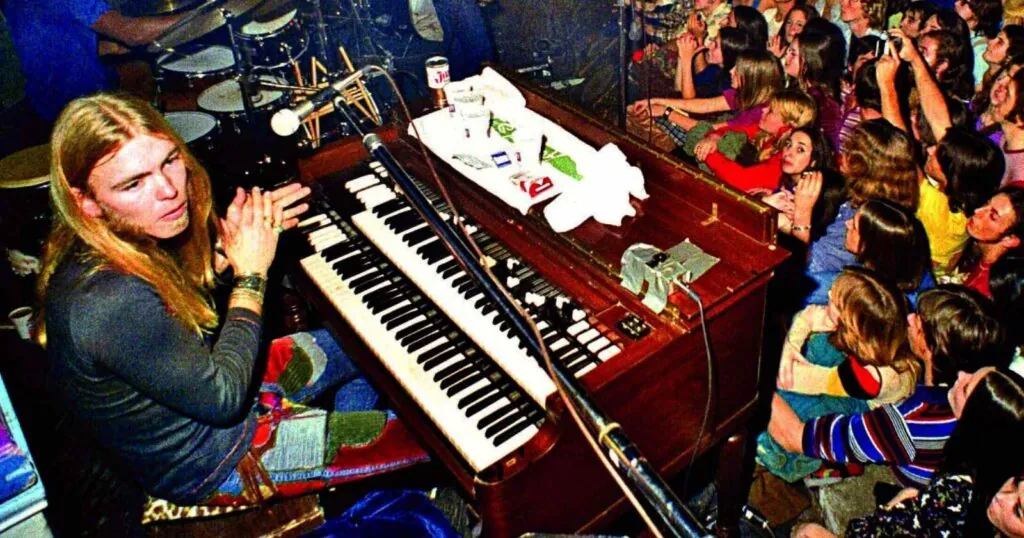
Reviews detected a sense of urgency in the record’s shorter blues numbers “Statesboro Blues” and “Done Somebody Wrong” in comparison to longer tracks such as “You Don’t Love Me” and “Whipping Post.” Other reviewers drew attention to the instrumentals “Hot ’Lanta” and “In Memory of Elizabeth Reed.” Santosuosso called “Stormy Monday” “as good as anything else on the album, a sort of tonic in its decelerated, relaxed manner.” In “Stormy Monday,” Wishik found “the soft and gentle side of the group. Duane is picking the most fragile notes he can find while Dickey Betts is softly sliding in and out, over and behind him and Gregg Allman is lifting the whole thing very gently with a beautiful rhythm pattern from the mighty Hammond B-3 organ.”

Most critics considered At Fillmore East an authentic representation of the Allman Brothers Band live. “Musicians’ musicians,” the Clemson University Tiger called the ABB, “one of the best instrumental groups in the country.” Jim Conley assured readers, “You won’t be bored, even though there are only seven cuts on the four sides. From soft mellow blues to cooking rock, they just do it all right.” Aregood called the album “excellent from beginning to end. The excitement they generate in live performance manages to leak through on the recording.”
Glover found Duane Allman’s musical vision at the heart of At Fillmore East. “In these days of so many groups who are merely competent, and ritualized sets which mostly bore your ass off. It’s a real joy to hear a group that loves to play and can communicate their enthusiasm.” The album demonstrated that “not only have they got their chops together—but that they know how to use them to create thick, smoking tapestries of blues and rock, tempered with a lyrical aching beauty.”
Though Duane stood out, “sliding out sinuous solos that coo, with southern soul, [he was] only part of the web. Brother Gregg sits high atop his organ, throbbing out long lines of swirling sounds, doing most of the vocal work with a mellow rasp while Dickey Betts plays alternate lead guitar, often in rippling counterpoint to Duane’s loping runs. The rhythm section of double drummers Butch Trucks and Jai Johanny Johanson, bottomed by cooking bassist Berry Oakley are always right there, driving it all along with power and a fine sense of dynamics.”
On Fillmore East, Duane’s music speaks for him and his bandmates. “His complete confidence—like the complete confidence of his band—is right out there,” Scoppa wrote. “No nonsense. He heads straight for whatever he’s after.” Rolling Stone’s Dubro asked after an ABB run in in California in January 1971, “Where do they want to go from here? Mostly they all seemed to want to do what they’re doing. It didn’t seem like they wanted to be stars, just musicians.” Duane had said as much backstage during the Fillmore East sessions in March 1971 when he told Glover, “We’re a band man, a band that works like a band. If we could just get people to come out and see us I know they’d like what they heard.”

The completed album sounds like a band that took immense joy in playing. Duane quotes Robert Johnson’s “Come on in My Kitchen” and “Joy to the World” during “You Don’t Love Me” and playfully teases the seventeenth-century folk song “Frere Jacques” as “Whipping Post” winds down. Stage banter gives insight into band members’ personalities. Duane introduces Elmore James’s “Done Somebody Wrong” as “an old, true story” before adding, “Wonder who?” He introduces “Stormy Monday” as “an old Bobby Bland song” before correcting himself. “Actually, it’s a T-Bone Walker song.”
Oakley announces “Brother Gregg Allman singing the blues! Duane, Dickey, and Ace [Thom Doucette] playing ’em!” Duane introduces “In Memory of Elizabeth Reed” as “a song Dickey Betts wrote from our second album” and “Whipping Post” as “a little number from our first album, Berry starts ’er off.” In anticipation of the band’s set closer, at least five folks yell out “Whipping Post” before Berry plays a note.
Song introductions and interludes on At Fillmore East also highlight the decision to market the Allman Brothers Band as the People’s Band. Glover called them “natural, no bullshit people.” Other recordings from the era prove the band’s Fillmore East stage announcements weren’t a put-on. Duane and his mates enjoyed themselves on stage, and they let audiences know that.

At Fillmore East also provides a clear example of Butch Trucks’s classical influence on the Allman Brothers Band’s sound. The influence might at first seem obscure because while the ABB’s music was complex like classical, but it was also improvised, less structured. Butch’s classical influences inspired the band’s tempo changes and dramatic movements. He translated the “feel” of classical to rock, using the tympani to bring “Hot ’Lanta” and “Whipping Post” to dramatic conclusion. The latter closed the album, fading as the band segued into “Mountain Jam.”
After two-plus years of relentless touring, the Allman Brothers Band had finally broken through. The success of At Fillmore East proved Duane’s theory about the importance of a live album for the Allman Brothers. Sadly, he missed out on the success and widespread acclaim the ABB achieved as a result of his artistic masterpiece. On October 29, 1971, just four days after the album hit gold, Duane died in a motorcycle crash in Macon. He was just shy of his twenty-fifth birthday.
Written by Bob Beatty, author of Play All Night! Duane Allman & the Journey to Fillmore East

Bob Beatty