
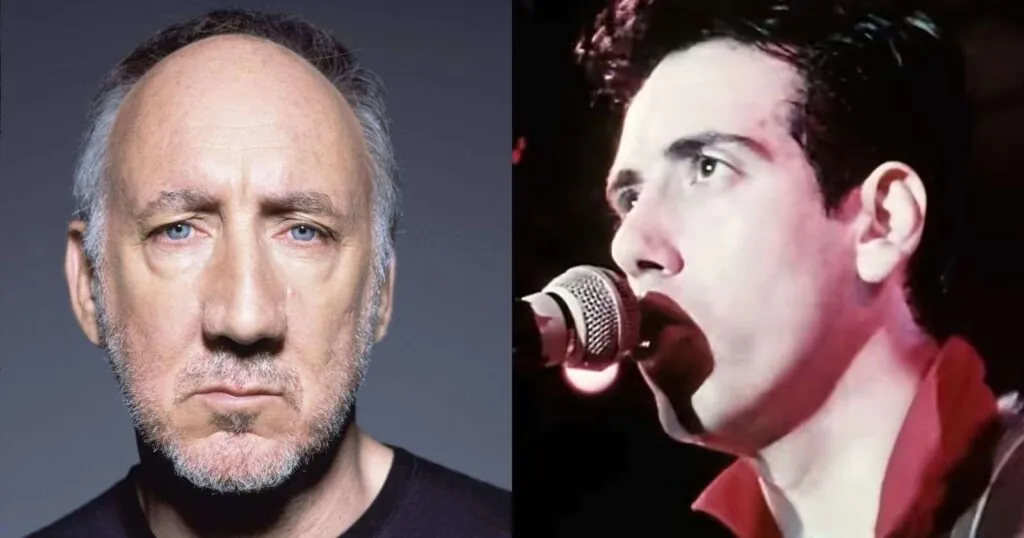
The mastermind behind The Who, Pete Townshend has been the band’s principal songwriter since its inception in the early 1960s. His songwriting and innovative guitar style helped shape the evolution of rock music and inspired countless musicians.
Having spent virtually his entire life in the music business, he has witnessed the rise of many different bands and subgenres, each leaving its own mark on rock history. Over the decades, many of those bands had the opportunity to open for The Who, including one that he said that back in the 80s was actually better than The Who were at the time.
The opening act Pete Townshend said was better than The Who
“When we did gigs with The Clash supporting us, it was quite clear that The Clash was a better band than we were by that time. We still did a good job but we weren’t new, we weren’t fresh. We weren’t angry, we weren’t up to make changes. So it seemed then, that what actually happened was that I’ve lost my mandate, my script, my idea of what to do.”
“I remember having a meeting with the guys in the band. (To say) ‘what can I write songs about for you guys that you feel you would be happy with?’ It didn’t get much of a reply. But I ended up writing a bunch of songs that are now considered ‘The Who’s worst album’. So they weren’t a very good audience to write for (laughs),” he said in an interview at University of London in 2024 (Transcribed by Rock and Roll Garage).
The Clash famously opened for The Who during their 1982 North American tour. The most famous performances took place at Shea Stadium in New York City, where they played in front of more than 100,000 people. On the second night, the band recorded the live album Live at Shea Stadium, which also provided the footage for the music video of their hit song “Should I Stay or Should I Go.” In his autobiography “Who I Am”, Pete recalled he instantly liked the members of The Clash when he first met them.
He said:
“Chris Chappel, who worked for Bill Curbishley, escorted me to see U2, The Clash and Bruce Springsteen. Chris was a young, hip dude, a massive Clash fan, and his enthusiasm was infectious. I thought The Clash were spectacular. They were charming to me when we met, and Joe Strummer clearly had a heart of gold. His work for political causes, especially anti-racist ones, was inspiring.”
“Chris began to act as advisor to me in all things young and cool. I took to wearing baggy suits and brothel-creepers, piling my thinning hair on top of my head like a rocker. Always a pretty good dancer, I stopped idiot-dancing and danced like Mick Jones and Paul Simenon from The Clash. At 34 I was still just about young enough to pull it off.” Pete Townshend said.
The difference between The Clash and Sex Pistols according to Pete
The two most successful British punk rock bands are the Sex Pistols and The Clash. Although they shared some similarities, they were quite different, each with its own unique sound and songwriting style. Pete once explained the difference between them, saying: “Three extraordinary artists like The Sex Pistols, The Clash and Elvis Costello under the banner of Punk is really an indication of how categories fail, miserably to attend to. What was actually happening at the time was the need for another tidal wave. I suppose that everybody wanted one band to do it like it happened to The Beatles. It turned out not to be one band but a lot of bands.”
“The Sex Pistols were obviously the most significant because they were the first. And because (Malcolm) McLaren was organizing them and allowing their anarchy. He gave them the space to play, the space to be anarchic. But also because I think Paul Cook and Steve Jones in the band are great Rock and Roll players. They say they couldn’t play but they actually could play very, very well. John Lydon is a fucking star! You know, he is a star! He is just one of the world stars, you see him and you know: ‘He is going to be famous’”.
He continued:
“The Clash are different because The Clash were kind of a boy’s band. To some extent like The Who were in the very early days. You know, a gang band. Kind like a fellowship band they gathered together people and they kind of went around following them around. I suppose that Costello was the brains in charge of the whole thing, I don’t know. But that’s a summing up of what happened. It was very, very exciting, challenging and there was a hell of a lot of pain there for Pete, I must say (laughs). Because I kind of welcomed, challenged and wanted it to happen. Then I realized that the person that they wanted to shoot was me,” he told Time in 1995 (Transcribed by Rock and Roll Garage).
When The Clash opened for The Who, they had already released five studio albums, the most recent being Combat Rock. At the time, the band still featured its classic lineup of Joe Strummer, Mick Jones, Paul Simonon, and Nicky “Topper” Headon. After that year, however, the group underwent major lineup changes following Jones’ departure and went on to release only one more studio album, Cut the Crap (1985).
What Mick Jones said about the experience of opening for The Who
The Clash’s guitarist Mick Jones is a fan of The Who and recalled once in an interview with CNN, how important it was for him and the band to be their opening act. “I remember once, I was talking to Pete Townshend (at a stadium show). I said I know what “Quadrophenia” means now, because if you look in one direction, you’re ignoring 50,000 people! He just looked at me like I was mad. It was a big thing, but we had something we wanted to say. So it was interesting to see how we’d get on in that environment,” Mick Jones said in 2013.
Like The Who, The Clash also formed in London but 12 years later, in 1976. They were active until 1986 and the vocalist, guitarist and main songwriter Joe Strummer passed away in 2001 at the age of 50.