

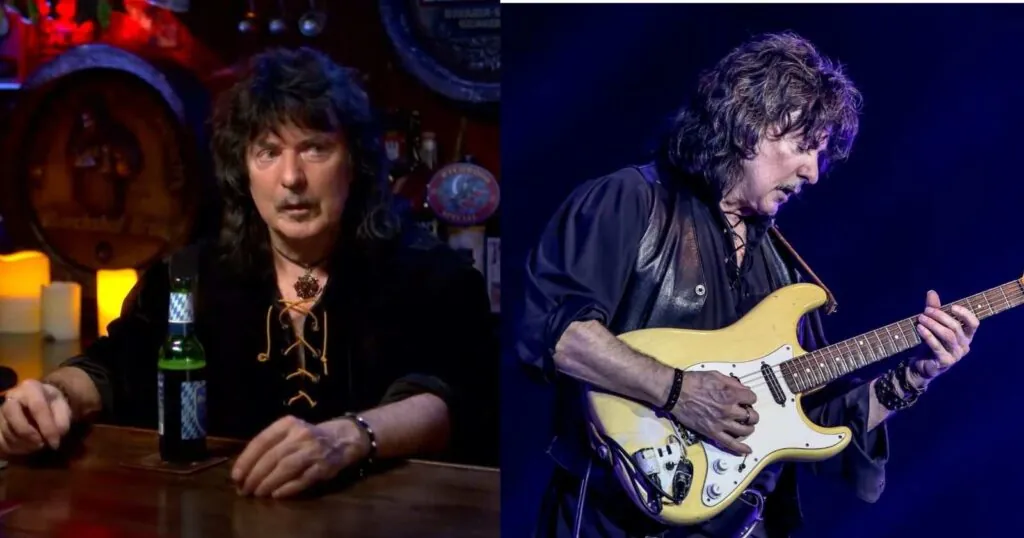
Ritchie Blackmore never minced his words when talking about other musicians, especially guitar players. He has always been quite sincere and especially during the first years of his career he gave his opinion on many British guitarists. There is one in particular who he even said made music that he thought he would probably hear on the way down to hell.
The guitarist that Ritchie Blackmore said made music from hell
John McLaughlin, British guitarist best known for being the leader of Mahavishnu Orchestra is the one who made music that to Blackmore’s ears in the 70s were like what he expected to hear in hell. “McLaughlin thought that puttin’ a fuzz on guitar would give him a good Rock N’ Roll sound. He’s a jazz guitarist. He can’t bend a note. He does it with such speed and complexity that it sounds good, but that fuzzy noise that he puts on everything blows it.”
“I don’t understand it. Jerry Goodman’s got that completely true sound. He’s very articulate. And Billy Cobham, I thought, was very good. But McLaughlin is beyond me … to me, it’s like music from hell. If I was going to hell, that’s the type of music I should expect to hear on the way. Roy Buchanan is brilliant. He goes way above people’s heads, and that’s what worries me. I think, what’s the point of being up there, if it’s going to go over everyone’s heads?”
“You’re not going to get anywhere. Pete Townshend once said that it’s great to progress, but unless you take your audience with you, it’s pointless. I think sometimes Buchanan is too far up front. People don’t know what he’s doing,” he told Cameron Crowe in an interview with Creem magazine in 1975. Funny enough, Jeff Beck, who was Blackmore’s favorite guitar player, said in 2001 that McLaughlin was “probably the best player around”. They played together many times over the years.
Ritchie Blackmore said:
“I still favour John McLaughlin as probably the greatest player around. All the others are just huge stars that everybody loves because they’re fantastic, you know. But I think John needs a mention because he just stays underground. He doesn’t encroach on Rock ’N’ Roll or the Blues as much; he plays wonderful jazz guitar in his own style. And then the next minute he’s playing with Indian guys with tabla and clay pots. He’s just amazing,” he told Steve Newton.
Blackmore thought there was no point doing music that only musicians would understand
At the time, the main reason Ritchie Blackmore didn’t like John McLaughlin’s playing was that he thought it was overly complicated, making it difficult for the audience to understand what he was playing. In his opinion, only other musicians could truly appreciate what McLaughlin was doing. “You can’t expect, I suppose, the people in the audience to be musicians. I know the bands you’re thinking of and those particular bands will turn people on for a length of time because the people in the audience aren’t musicians. They don’t want to go see John McLaughlin. I personally get bored listening to John McLaughlin play.”
“I’m a so-called musician, but I get bored. ’Cause I think `Well, what is he?’ That’s great, you know, if he really likes it, and there’s a minority of people that do like it, but the majority would rather go and see these other bands because they put on a show. I can see the reasoning behind that, which is valid really. But it’s showbiz. It’s not music,” he told Sounds magazine in 1976.
The guitar technique both Blackmore and McLaughlin used
These days “scalloping” has been used by many different guitar players over the decades in their music but it was something that hadn’t been done that much in the late 60s when Ritchie Blackmore first used it. John McLaughlin also adopted that into his playing and the Rainbow leader once talked about that. “Yeah – for what it’s worth, I was the first one to do it – everybody thought I was crazy… I did that way back, in about ’69, I suppose. And then John McLaughlin did it in about ’75. And then of course they all started doing it after that.”
“I always thought that it was the right thing to do. Because you find that, when you’re playing a Fender especially, you push the string over, and you’re hoping it’s going to hang there, cause it starts to drift under the finger. And I’d think, well. surely it should be more concave, so that you can really push it over and keep it there, and feel confident that the string is going to stay up there,” he said in an interview with Paul Guy in 1998.
McLaughlin has been awarded multiple times over the decades and is consistently listed among the greatest guitarists of all time. Curiously, in Rolling Stone magazine’s list of the 250 greatest guitarists of all time, Blackmore is ranked at number 75, while McLaughlin is slightly ahead at number 72.