
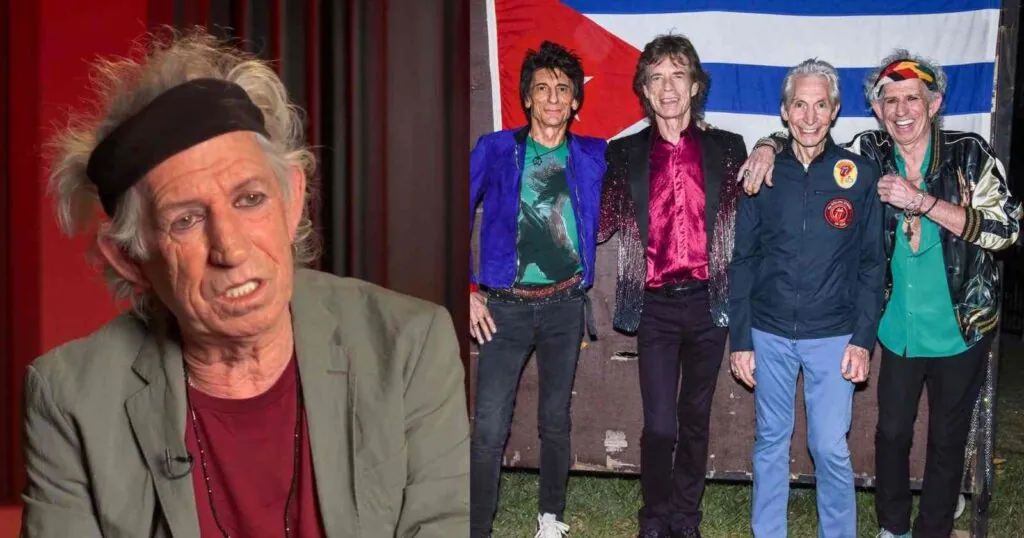
Since the early 1960s, led by Keith Richards and Mick Jagger, The Rolling Stones have released more than 30 studio albums and over 120 singles, which makes them one of the most enduring and prolific Rock and Roll bands of all time.
Fans have an enormous body of work to explore and it is not easy to choose the greatest songs, which means there are many hidden gems in their discography. There are 3 underrated tracks, Keith Richards once described as “damn good.”
The 3 Rolling Stones songs Keith Richards said were “damn good”
“Country Honk”
The first one mentioned by Keith Richards is “Country Honk” which is the original version of what would become later on “Honky Tonk Women”. The track was written by Keith and Mick when they were spending time in Brazil in the late 60s. “We were headed for the Mato Grosso (Brazilian state). We lived for a few days on a ranch, where Mick and I wrote ‘Country Honk.’ (We were) sitting on a veranda like cowboys, boots on the rail, thinking ourselves in Texas.”
“It was the country version of what became the single ‘Honky Tonk Women’ when we got back to civilization. We decided to put ‘Country Honk’ out as well, on ‘Let It Bleed’, a few months later in late ’69. It was written on an acoustic guitar, and I remember the place because every time you flushed the john these black blind frogs came jumping out. (It was) an interesting image,” Keith Richards said in his autobiography “Life”.
Interestingly Richards later said that quite often a good Country song can also become a very good Rock and Roll track. “It was a process, writing ‘Country Honk’ and saying: ‘This sounds like Jimmie Rodgers or Hank Williams. (But) how he would have played now (these days)?”
Keith Richards continued:
‘So then (we) project it forward but at the same time is a damn old good Country song and a damn old good Country song is quite often a damn good Rock and Roll song,” Keith Richards said on his Youtube channel (Transcribed by Rock and Roll Garage).
“Country Honk” was featured on the band’s eighth studio album, “Let It Bleed”, released in 1969, a few months after “Honky Tonk Women” had come out as a single and became a number one hit in several countries. It is one of the few songs from that era that did not feature bassist Bill Wyman, as there is no bass on the track. Besides Mick Jagger and Keith Richards, Mick Taylor played steel slide guitar, Charlie Watts handled the drums and guest musician Byron Berline played fiddle.
“Love In Vain”
Also from “Let It Bleed”, the song “Love In Vain” was also mentioned by Keith as a “damn good” one and also a track that showed how talented Mick Taylor was. “We did the most brilliant stuff together, some of the most brilliant stuff the Stones ever did. Everything was there in his playing—the melodic touch, a beautiful sustain and a way of reading a song. He had a lovely sound, some very soulful stuff. He’d get where I was going even before I did.”
“I was in awe sometimes listening to Mick Taylor, especially on that slide—try it on ‘Love in Vain’. Sometimes just jamming, warming up with him, I’d go, whoa. I guess that’s where the emotion came out. I loved the guy, I loved to work with him, but he was very shy and very distant. I’d get close to him when we were working out stuff and playing. When he let his hair down he was extremely funny,” Keith Richards said in his book “Life”.
The song is a version of “Love in Vain Blues”, written by the legendary Robert Johnson and released in 1939. At the time, Mick Taylor had only recently joined the band, coming from John Mayall and the Bluesbreakers, a position previously occupied in that group by Eric Clapton and Peter Green. “Let It Bleed” was his first album with the Stones, and as Keith once said, it brought “beautiful possibilities” to the band’s sound. “Taylor opened up some beautiful possibilities. Especially in recording because I would just lay down 3 or 4 different rhythm guitars. Mick was very much a solo player. Incredible melodic and sensitivity about his playing. Most of those early Stone records, you know, the big ones.”
Keith Richards continued:
“He’s probably 6, 7 maybe 8 sometimes, guitars on these tracks. But you wouldn’t know that. When I play guitar I wanna play with another guy. If he is providing the other side of the coin, if I’m laying down that rhythm then the complements that come from the other guitar then will be moving into the rhythm guitar,” Keith Richards said on his Youtube channel in 2017 (Transcribed by Rock and Roll Garage).
Taylor remained a member of the band until 1974, when he decided to leave to spend more time with his family. He also played on the albums “Sticky Fingers” (1971), “Exile on Main St.” (1972), “Goats Head Soup” (1973) and “It’s Only Rock ’n Roll” (1974). Over the decades, Richards has said many times that his favorite Stones albums come from this era with Mick Taylor in the band.
“Dear Doctor”
Released one year before the other two songs on the list, “Dear Doctor” was part of the final Stones album in which Brian Jones still played a significant role. “Mick was coming up with some great ideas and great songs, like ‘Dear Doctor’. I think probably Marianne (Faithfull) had something to do with that (song). (…) (These 3 songs listed) were, in a way, catch-up, things we had to do. The mixture of black and white American music had plenty of space in it to be explored.”
“We also knew that the Stones fans were digging it, and there were an awful lot of them by then. Without thinking about it, we knew that they’d love it. All we’ve got to do is what we want to do and they’re gonna love it. That’s what we’re about, because if we love it, a certain thing comes across from it. They were damn good songs. We never forget a good hook. We’ve never let one go when we’ve found it,” Keith Richards said in his biography “Life”.
Keith mentioned Marianne, since the song was written during the period when she and Mick were together. They were in a relationship from 1966 to 1970. Besides the full Stones line-up, the track also featured legendary session musician Nicky Hopkins on tack piano.