
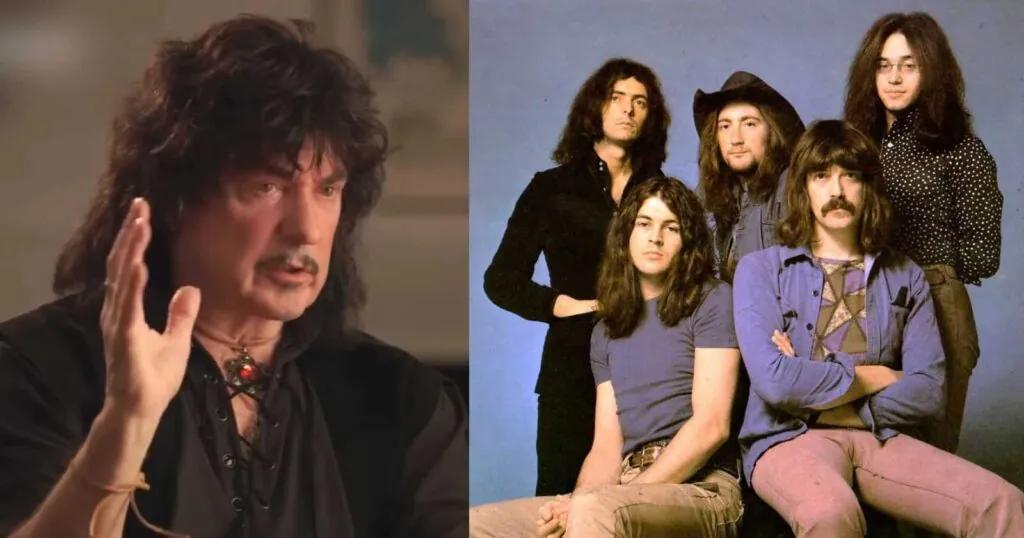
Although Ritchie Blackmore has not been a member of Deep Purple for more than three decades, he remains one of the key architects of the band’s sound.
He played on all of their most successful albums and wrote some of the greatest guitar riffs and solos not only in Deep Purple’s catalog, but in the history of rock music. Over the years the guitarist talked about many records he was part of and revealed which are his three favorite ones.
The 3 Deep Purple albums Ritchie Blackmore said are his favorites
1 – “Machine Head” (1971)
“My favourite (Deep Purple) LP would be Machine Head,” he told The Guardian in 2015. Besides the music itself, he thought Ian Gillan’s vocals were really good. “Machine Head” (1972) I thought Gillan was singing great and the band was playing great, two great LPs. I think ‘Deep Purple in Rock’ was underestimated, especially in America. They only know ‘Machine Head’ and I think ‘Deep Purple in Rock’ had the edge (of) ‘Machine Head’. We did it very quickly and very naturally and it was fun to make those two LPs,” Ritchie Blackmore said on his Youtube channel (Transcribed by Rock and Roll Garage).
Curiously, the band’s most famous song, “Smoke on the Water”, was almost not recorded in the form we know today because of the police. Ritchie Blackmore recalled that while Deep Purple were recording in Switzerland, they were playing so loudly late at night that the police showed up and demanded they stop. The band refused to open the doors until they had finished recording the track.
“We did the whole thing in about for takes, because we had to. The police were banging on the door and we knew it was the police. But we had such a good sound in this hall, that we were waking up all the neighbors for about five miles in Montreux. Because it was echoing through the mountains. The police were there banging on the door, wanting us to stop but we wouldn’t let them in.”
He continued:
“So they were like crashing their way through the door and I was just getting the last part of the riff down and we got it down. We just finished and the police burst in and said ‘You’ve got to stop’. We said: ‘It’s alright, we’ll stop’. But we had the track down, that was the only one track that we did in this one hall in Montreux,” he said in an interview made available by Backstage Pass (Transcribed by Rock and Roll Garage).
“Machine Head” is Deep Purple’s best-selling album and besides “Smoke on The Water” has classic songs like “Highway Star” and “Space Truckin'”. Curiously, “Pictures of Home”, a track they played a lot live during their career, wasn’t appreciated by other bands members at first. Blackmore once said that he was one of the few who liked when they were working on.
Ritchie Blackmore said:
“I really like Pictures Of Home, because it is very melodic. There were some members of the band that didn’t like that one at all. I heard the riff for that on a shortwave radio. It was probably coming from Bulgaria or Turkey, or somewhere like that. One of these days, these Bulgarian/Turkish people are going to come out the woodwork, saying: ‘I wrote that.’”
“I remember the rest of the band were a little worried about Ian singing about eagles and snow. I never listen to lyrics anyway, unless it’s Bob Dylan singing. So I said: “Well, eagles and snow. Sounds good enough to me, carry on,” Ritchie Blackmore said in an interview with Classic Rock in 2023 that the other members of the band didn’t like the track.
2- “Deep Purple in Rock” (1970)
In second place, Blackmore chose Deep Purple in Rock, which he said was not far behind Machine Head in terms of quality. The album marked a turning point for the band, as they decided to pursue a heavier sound, taking inspiration from what Led Zeppelin was doing at the time. “In the beginning, I was a little bit lost as to what style I really had. And then everything clicked with In Rock. Ian Gillan (vocals) and Roger Glover (bass) had come in, so that gave us new blood. I found my niche being much heavier music, and playing with more sustain on the amplifier, that sort of thing.”
Ritchie Blackmore continued:
“We consciously sat down and said, “Let’s have a go at being really heavy.” It was after hearing Zeppelin, I think. Gillan had this big voice. I had looked for Ian Paice for about a year after seeing him perform in Hamburg. He’s an incredible drummer. And he was the motor of the band,” Ritchie Blackmore told Guitar in 2010.
Released in 1970, Deep Purple in Rock was the band’s fourth studio album and the first to feature the classic Mark II lineup. It marked the debut of vocalist Ian Gillan and bassist Roger Glover, who became crucial contributors to Deep Purple’s signature sound and songwriting during its most successful years. The album includes classics such as “Speed King”, “Child in Time”, “Hard Lovin’ Man” and “Black Night”, although the latter originally appeared as a non-album single before being added to later editions.
Blackmore later said he was pleased with the album’s success because it convinced him the band would no longer have to perform with orchestras, something keyboardist Jon Lord had been especially fond of.
3 – “Burn” (1974)
In third place, Blackmore chose “Burn”, saying it was also very close in quality to the first two albums he had mentioned. “I felt great about ‘Burn’ because we’d had a year to write it. See… ‘In Rock’, ‘Fireball’ down, ‘Machine Head’ up, ‘Who Do We Think We Are?’ down, ‘Burn’ up,” he told The Guardian.
He had also explained that he actually didn’t like all the tracks of the record. “‘Burn’ is excellent, I like that very much. The songs ‘Burn’, ‘Mistreated’ and ‘Lay Down, Stay Down’, it was all good stuff. ‘Stormbringer’ I didn’t like at all. (…) ‘Burn’ is a great LP. (After that) We started getting into the pseudo-bluesy offbeat stuff. In fact I played just one track with my thumb, it was a Glenn track. It was a shuffle, I didn’t like it at all. But I said I would play it and I did play it. But I only played with my thumb (laughs). That was my way of rebelling against, (saying) ‘I don’t like this’. ‘Hold on’ (is the name of the song).”
He continued:
“(I quit) the band, because I thought the band was starting to get very lazy. They were very preoccupied with themselves and I thought I could form another band. Because I personally felt that I was doing too much. I felt I could do that with another band that didn’t have the egos. There were a lot of egos at that time,” he said in an interview with Metall Magazinet in 1993 (Transcribed by Rock and Roll Garage).
Released in 1974, Burn was the first Deep Purple album after the departures of Ian Gillan and Roger Glover. It also marked the debut of vocalist David Coverdale and bassist/vocalist Glenn Hughes, ushering in the Mark III lineup. Besides the title track, the album features other fan favorites such as “Might Just Take Your Life”, “Mistreated” and “Sail Away”.