
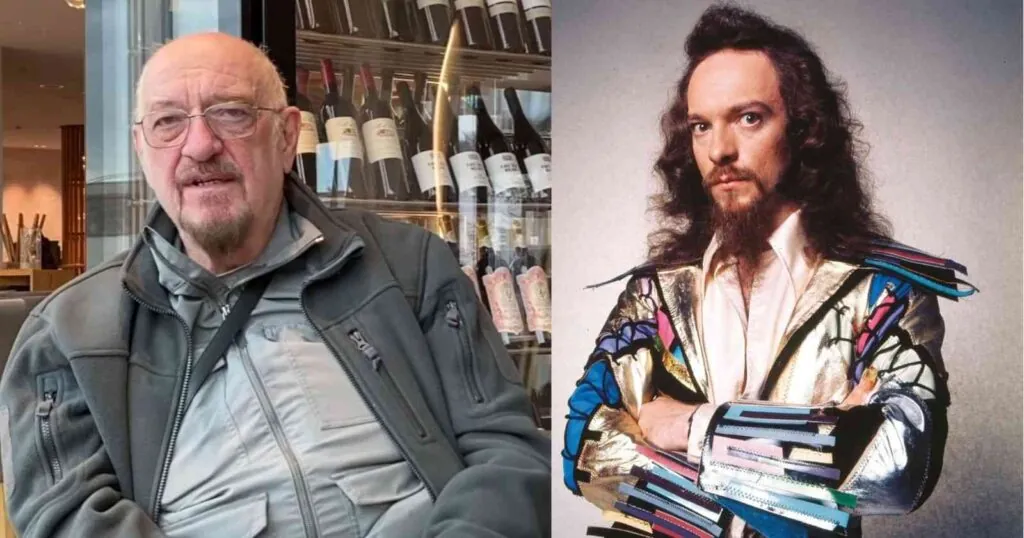
Over the past almost six decades, Jethro Tull has consistently released albums that have inspired countless generations of musicians. Led by Ian Anderson, the band’s co-founder, vocalist, multi-instrumentalist, and main songwriter, they became one of the most successful Progressive Rock bands of all time, with an estimated more than 60 million records sold worldwide.
Over the years, Anderson has talked about many of his favorite songs but has also named two that he is not a big fan of, although they were quite successful.
The 2 Jethro Tull songs Ian Anderson is not a big fan of
“Bungle in the Jungle”
The first song Ian Anderson said he is not a big fan of is ‘Bungle in the Jungle,’ because it was one of the tracks he wrote while trying to make something catchy and radio friendly. “I would try to write or create catchy things, popular, easy on the ear pieces in favor of just trying to be a little more creative in a a more idiosyncratic fashion that isn’t necessarily going to appeal to everybody or even most people. So I think that would probably sum me up, I don’t write popular music.”
“I write, broadly speaking, unpopular music (laughs). If you’re talking about the average tender sensitivities of the average punter’s ears, then you know, I’m not a popular music artist. (He continued about ‘Bungle in the Jungle’) That’s the problem. Things like ‘Bungle in the Jungle’ or even ‘Living in the Past’, which was done almost as a throwaway bit of fun. ‘Bungle in the Jungle’ was a little more insidious because I did really try to write a piece of music that was going to be catchy,” Ian Anderson said in an interview with Classic Album Review in 2025 (Transcribed by Rock and Roll Garage).
Anderson’s original intention worked out, as the track, featured on the 1974 album “War Child” was also released as a single. It ended up becoming a hit in the United States, peaking at number 12 and number 5 in Canada. Although it became a successful song, Ian Anderson told Rock History Music, that is not among his top 20.
He said:
“It was a track, a quite good track. (It was) deliberately written for that album to try get something that was radio friendly. I don’t feel in no ways as a second-rate song or something that I’m not happy with it. It’s just that for me musically and styling-wise, it’s a little bit obvious. I still think is a pretty good song. But I wouldn’t put at the top 20 of my list of favorite Jethro Tull songs. But I wrote it very intentionally to try to get something that had a sing-along happy chorus,” Ian Anderson said in an interview with Rock History Music in 2019 (Transcribed by Rock and Roll Garage).
On that particular track, Ian Anderson played flute and acoustic guitar and also recorded the vocals. Also taking part were Martin Barre (electric guitar and Spanish guitar), John Evan (piano, organ, accordion and synthesizers), Jeffrey Hammond (bass) and Barriemore Barlow (drums). The orchestral arrangements were done by David Palmer. Jethro Tull didn’t play the song that often live, performing it just over 140 times. The most recent time it was featured in one of their concerts was in 2001.
“Too Old to Rock ’n’ Roll: Too Young to Die”
“(…) With ‘Too Old to Rock ’n’ Roll: Too Young to Die’. (Both songs) had that chorus that I suppose made them get a lot of radio play, particularly in USA, where getting radio play really mattered when it came to promote a new album. So I did allow myself to do that. But the end result is (that) when I listen to those songs today I think: ‘Oh yeah, that’s quite clever, quite nice’. But it quickly, on a second listening, begins to irritate me, because I can see what I’m doing. I remember why I did that, what was the musical motivation to come up with those lines lyrically and musically.”
“(It was) to sound attractive to people. Many of the greatest bands have managed to do that, but to be creative at the same time. I mean, Led Zeppelin, The Rolling Stones. They managed to come up with really catchy riffs and catchy ideas which don’t just slip into that world of pop tinsel,” Ian Anderson told Classic Album Review in 2025 (Transcribed by Rock and Roll Garage).
Ian Anderson said that he will be too old to Rock and Roll when Keith Richards dies
Because of the song’s title, Anderson has frequently been asked over the decades about retirement and when he would be ‘too old to Rock ’n’ Roll.’ In one of his most recent answers, he said that would happen when Keith Richards dies.
“When Keith Richards dies (smile). Well, because the Stones I suppose are the longest surviving real rock band. Mick Jagger seems to be in pretty good shape. Keith Richards I’m not sure about it. But you know, they’re pretty old guys, they’re older than me. So they’re a good example. Paul McCartney is older than me too, Elton John is the same age as me. There are a few others that are younger than me like Phil Collins, he’s definitely too old to do anything. Not too old, he just have been very unlucky with his health. So as long as you are feeling mentally and physically focused and capable of doing things we don’t have a time limit.”
He continued:
“If I was a British Airways 787 pilot I would have to have retired 12 years ago. So I think of myself belonging to a profession where we, like a cowboy in a western movie. We die with our boots on. We don’t quietly fade away, we carry on until something forces us to quit, which could be anything. Obviously, many past members of our band have been unlucky with health and not any longer been able to play music or function properly. Some of them sadly passed away. So I’m so far quite lucky. I always eat my greens. I eat my spinach, my cabbage,” Ian Anderson said in an interview with Rock News Switzerland in 2025 (Transcribed by Rock and Roll Garage).
As Anderson previously said, ‘Too Old to Rock ’n’ Roll: Too Young to Die’ was another song he wrote with the intention of reaching a bigger audience. It became the title track of the band’s 1976 album, which is considered their last concept album. The record tells the story of a fictional aging rocker named Ray Lomas. It was their only 1970s album that failed to achieve gold certification. The album peaked at number 25 on the UK Albums Chart and number 14 on the United States Billboard 200. Released as a single, the song was not commercially successful but became a fan favorite over the decades. The band has often featured the track on their setlists. The played it more than 700 times since its release.