
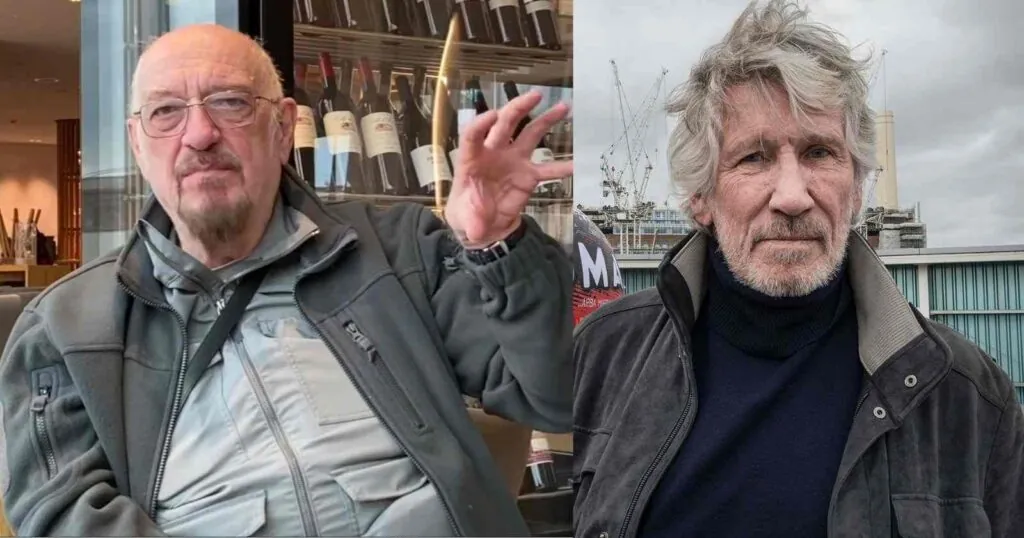
Ian Anderson was a crucial figure in the evolution of Progressive Rock, being one of the most important songwriters and musicians in the genre. Leading Jethro Tull over the past six decades, he has influenced countless people around the world and has been praised by many of his peers.
During his career, he has given his opinion on many other British bands from their era and on various musicians, including Pink Floyd’s bassist, singer, and main lyricist Roger Waters.
What is Ian Anderson’s opinion on Pink Floyd’s Roger Waters
Ian Anderson admires Pink Floyd and has credited the band as an influence, recognizing Roger Waters’ importance as a songwriter, but he does not agree with many of his ideas and comments about politics and world events. “Roger Waters is a wide-eyed innocent when it comes to politics and tends rather like the Tesla man to spout off, because he can, he has the willing ear of people. But Roger Waters, I happen to know for a fact, one of the places that I did go to support and visited in person in Israel, allowed some of its land to be used by Roger Waters for a big concert performance some years ago and I said to them: ‘Oh, that’s great that he did that’, being the ‘Oasis of Peace” (Neve Shalom), one of the major charities for co-education of Arabs and Jews.”
He continued:
“I was surprised to hear that he didn’t pay the ‘rent’ and gave us nothing at all at a time that he was playing in Israel, pocketing the dosh and going home. My view is that if you want to boycott Israel, it will not reach the ears of Netanyahu and (others), they won’t be hurt by such a thing because they don’t give a damn.”
“So the boycott of Israel achieves nothing, on the other hand to go there and get paid, like Roger Waters, go home with the money in your pocket, that’s equally not acceptable. My view is that I don’t want to profit from a war zone and so for many years I have donated the proceeds of our concerts, under of my control, not via the promoters, I don’t trust them, but I just feel that I can control the conduit for that money to reach the right charitable source at the end.”
He continued:
“I think that if you can do something that has an upside, even if it’s a tiny little immeasurable effect, it’s worth to do it, as opposed to doing something where it’s all downside. To me, being able to offer a few thousand euros or dollars into a charity that does something for human rights, women’s rights or supporting co-education facilities that depend entirely on the good will of others, because they don’t get it from the state, then I think that has an upside and if Roger Waters disapproved me having been to Israel, then I’m afraid that my views would be even more unequivocal than his seemed to be,” he said in an interview with Classic Album Review in 2025 (Transcribed by Rock and Roll Garage).
Two years earlier, in 2023, he had already criticized Waters’ behavior and ideas. “Why someone who’s been doing it as long as he has is seemingly unable to act on the understanding that it’s up to you to convey your ideas in a way that isn’t going to get you a drubbing. He’s loose-tongued with his convictions, which seem to be a little confused and perhaps not based on reality. He goes out there ranting and raving, as many others do,” he told Classic Rock.
Ian Anderson praised Roger Waters’ for having the courage to release a reimagined version of “Dark Side of The Moon”
In 2023, when Roger Waters released “Dark Side of the MOon Redux”, a reimagined version of one of the best-selling albums of all time, Ian Anderson praised him for the idea and courage. “Well, I’m sure there’s a bit of both, really. But I would certainly give Roger Waters the credit, artistically, to be doing it because he thought he was going to bring something new to what is already a well-attended and popular party that was in a part of the great history of rock music.
“So I’m sure that he wouldn’t be doing it only because of somehow getting back at former band members and coining in all the dosh for himself this time…,” Ian Anderson said in an interview with Classic Rock Review. Curiously, when “Thick as a Brick 2,” the sequel to Tull’s classic 1972 album, was released in 2012 under Ian Anderson’s name rather than the band’s, he said he was having a bit of a “Roger Waters” moment, wanting to show people that he was the one who wrote the original.
“It is what it is, what it says. It’s my album and that’s indeed the original Thick As A Brick, something I wrote – nobody else did, it was only me. So I guess I’m just having a slightly Roger Waters selfish moment and making people realize I am the author of this, not the members of the band that were there in 1972,” he told American Songwriter in 2013.
Almost a decade before, in 2005, Anderson was part of the Pink Floyd tribute album “Back Against the Wall”, which was focused on songs from “The Wall” (1979). He covered the track “The Thin Ice” with Tony Levin (Bass), Gary Green (Guitar), Jay Schellen (Drums) and Billy Sheerwood (Backing vocals).
“The Piper at The Gates of Dawn” was a huge influence for him
Pink Floyd’s debut album “The Piper at the Gates of Dawn,” released in 1967, was a seminal record for Anderson, who credited it, alongside The Beatles’ “Sgt. Pepper’s Lonely Hearts Club Band,” with helping give birth to Progressive Rock.
“There were two seminal albums in 1967 that carved a path for people like me in the progressive pop context. One was The Beatles’ ‘Sgt. Pepper’, of course. The other was an altogether more surreal and proggy affair, Pink Floyd’s ‘Piper at the Gates of Dawn’. Both albums took elements from lots of different sources and used them in colorful, creative ways.”
“For me, the Pink Floyd album had more meaning. The Beatles were a pop group. So I thought their stuff was a bit contrived, a bit twee. I liked the singer-songwriter element to Floyd more. Syd Barrett’s songs were strange and funny. They perfectly complemented the radical, druggy instrumental stuff the band did. You saw pictures and presented them with words and sound, rather than as paintings.,” Ian Anderson said in an interview with Classic Rock in 2020