
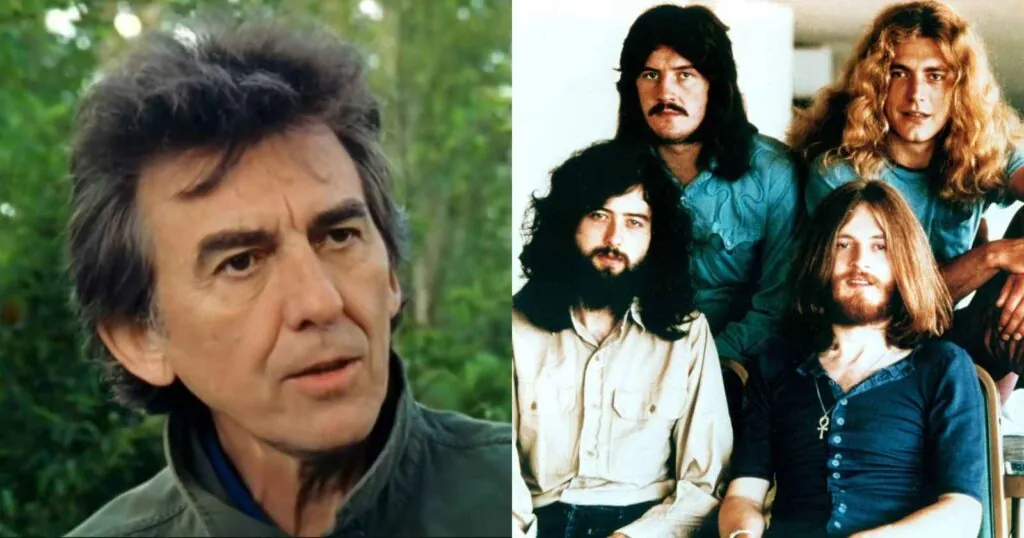
George Harrison was one of the most important contributors to The Beatles’ sound and proved that he was also an incredible songwriter, especially during his solo career. His work showed that he could have contributed much more had he been given more space alongside Lennon and McCartney. Like many musicians of his era, he didn’t immediately embrace other rock subgenres that emerged, such as Hard Rock and Metal, although he did praise some bands. Throughout his career, he shared his opinions on many of them, including Led Zeppelin.
What was George Harrison’s opinion on Led Zeppelin
At first, George Harrison didn’t get their sound, but he later started to enjoy the band and even hung out with them a couple of times, including throwing cake at John Bonham at the drummer’s 25th birthday in 1973. Led Zeppelin’s manager Peter Grant once recalled that moment, saying: “For Bonzo’s birthday party we hired a programme director’s house in the Hollywood hills. We ended up putting in new carpets for him.” Robert Plant chimed in: “Lots of luminaries arrived at this house after we’d played the LA Forum – George Harrison, Roy Harper, Keith Moon…”
Then Grant said: “Bonzo’s birthday cake was a wedding cake and George Harrison lifted the top layer straight into Bonzo’s face, with all this hard icing. There was no lateral thinking with Bonzo. He picked Harrison up and launched him into the swimming pool. Pattie Boyd came out screaming, so Colesy threw her in the pool. George said, ‘This is the greatest night of my life!’ And Atlantic (Records) made a poster of the bill for all the damages,” Peter Grant said
Harrison went to one of their shows at the time in Los Angeles, when they were promoting their album “Houses of the Holy”. He was impressed by the band during their three-hour concert, reportedly having said: “Fuck me! With the Beatles, we were on for 25 minutes and could get off in 15.”
The ballad Jimmy Page wrote after George Harrison complained to Bonham that they didn’t have any
The Beatle once complained to John Bonham that Led Zeppelin never wrote any ballads, although the band didn’t think the same. After Jimmy Page heard that, he decided to write a new ballad, and the result was “The Rain Song.” He even added a little nod to George Harrison’s “Something” as a response to what the musician had said.
“George was talking to Bonzo one evening. He said, ‘The problem with you guys is that you never do ballads.’ I said, ‘I’ll give him a ballad,’ and I wrote ‘Rain Song,’ which appears on ‘Houses of the Holy’. In fact, you’ll notice I even quote ‘Something’ in the song’s first two chords,” Jimmy Page said in the book “Light & Shade” by Brad Tolinski. Interestingly, as Bonham’s sister Deborah said in an interview with Rock Talk in 2022, her mom took her late brother to see The Beatles live when he was 14 and they had front row seats.
He said:
“Mom took them to see The Beatles when I think John was 14, Michael was 12. They went to see The Beatles and she had somehow managed to get front row seats, but they couldn’t hear anything. It was just girls screaming like mad. I think that was when John had decided, ‘Yeah, I want to do that.’ And he did, he ended up playing with Paul McCartney many, many years later,” she said.
Led Zeppelin guitarist and producer Jimmy Page also admired George Harrison but made it clear a few times that he had a sitar and learned how to play it from Ravi Shankar many years before Harrison. However, in his opinion, the Beatle played it better. “Let’s put it this way: I had a sitar before George Harrison got his. I wouldn’t say I played it as well as he did, though.”
He continued:
“I think George used it well. The Beatles’ ‘Within You, Without You’ is extremely tasteful. He spent a lot of time studying with Ravi Shankar, and it showed. But I can remember going to see Ravi in concert very early on. To show you how far back it was, there were no young people in the audience at all. (It was) just a lot of older people from the Indian embassy.”
“This girl I knew was a friend of his, and she took me to see him. She introduced us after the concert. I explained that I had a sitar but I didn’t know how to tune it. He was very nice to me and wrote down the tuning on a piece of paper. But it’s really hard for me to say exactly where I got my technique. Because it’s a combination of a lot of things that were floating around. Sometimes I tell people it’s a product of my ‘CIA connection’. (It) is shorthand for Celtic, Indian and Arabic music,” he said in the book “Light & Shade”.
George Harrison didn’t get Led Zeppelin when he heard their first album
The legendary English sound engineer Glyn Johns was the one who first presented Led Zeppelin’s music to George Harrison. He worked on their debut album and then with The Beatles on “Abbey Road” and “Let It Be”. It was during the sessions of the Fab Four’s final records that he asked if George wanted to hear the “new Jimmy Page album,” as can be heard in an audio of the “Let It Be” sessions.
Harrison replied: “Jimmy Page?” (Yeah, he just produced a new album with his new group.) “Is he the one that was in The Yardbirds?” Glyn then says they are incredible, tight and psychedelic. Also informing that John Paul Jones played bass, also mentioning “a kid called John Bonham on drums, who’s unbelievable. He comes from Birmingham”.
In an interview with UNCUT magazine in 2014, Johns recalled that George didn’t really get it at all. “I dragged George Harrison into Olympic (studio) to listen to it on the way back from a Beatles session. He didn’t get it at all, which I thought was extraordinary. Too set in his ways, maybe. I still think this album is their best. It shook everything from the roots,” he said.
Another curious connection between George and the band was that their manager, Peter Grant, hired American director Joe Massot, who had previously directed a movie called “Wonderwall”, which featured a soundtrack composed by George, to make what later became “The Song Remains the Same” (1976). Massot and Peter Clifton directed the classic movie, which mixed footage of their shows at Madison Square Garden with some “dream sequences”.