
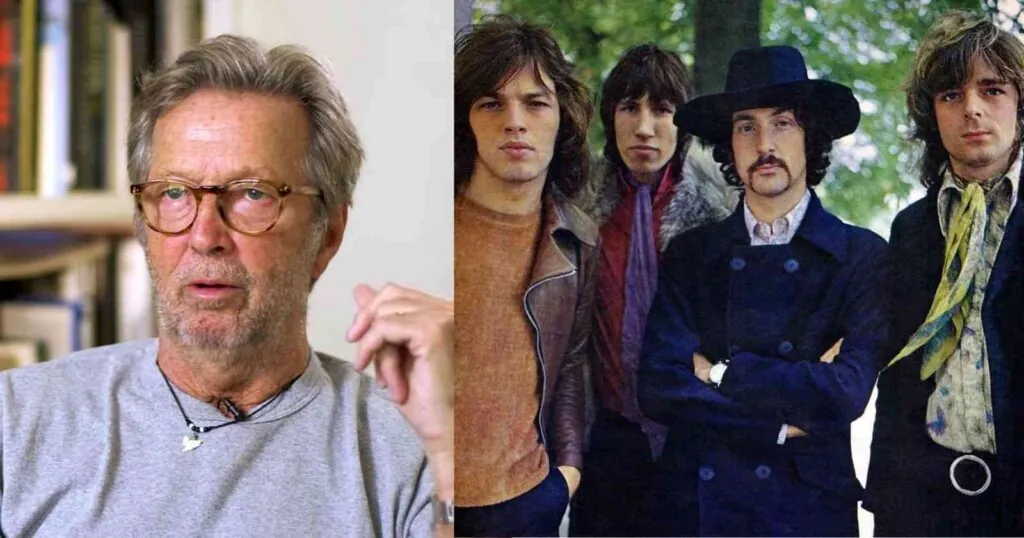
One of the most influential British musicians since the 1960s, Eric Clapton had the opportunity to witness the evolution of Rock music in the UK firsthand, seeing many famous bands perform in small clubs before they achieved widespread success. One of those bands was Pink Floyd, which helped shape what would later become known as Progressive Rock.
As early as 1968, when the band had released only two albums, Clapton was already aware of them. Over the decades, he has shared his opinion on the group originally formed by Roger Waters, Richard Wright, Nick Mason, and Syd Barrett, who was later replaced by David Gilmour.
What is Eric Clapton’s opinion on Pink Floyd
Eric Clapton is a fan of Pink Floyd and has been a close friend of Roger Waters for many decades. Curiously, when he was asked by Rolling Stone magazine about the band’s music in 1968, shortly after Pink Floyd began to gain attention, he said that he thought they were “very freaky” but were a good band. “Recording music has become so far out that you can’t relate it to live music at all (these days). I don’t think you have to. If you’re curious about performers, the Pink Floyd is one I like very much among live groups.”
“Very strange group. The nearest thing you would have to them here… Well, I can’t even think of a group you can relate them to. Very freaky. They’re not really psychedelic. They do things like play an hour set that’s just one number. They are into a lot of electronic things. They’re also very funny, they’re nice. They really are a very nice group and they’re unambitious and they give you a nice feeling watching them. They’re not trying to put anything over,” he said at the time.
Eric Clapton toured with Roger Waters as part of his band and played Pink Floyd songs
That year, the band had only released their first two studio albums “The Piper at the Gates of Dawn” (1967) and “A Saucerful of Secrets” (1968) and David Gilmour was still not known by the general public. In the following decades, Clapton played many Pink Floyd songs live with Roger Waters. He played electric guitar on the musician’s first solo studio album “The Pros and Cons of Hitch Hiking”, released in 1984 and hit the road with Waters as part of his band during the tour to promote the record that year.
During those shows, they typically performed a wide range of Pink Floyd songs, including “Set the Controls for the Heart of the Sun”, “Money”, “If”, “Welcome to the Machine”, “Have a Cigar”, “Wish You Were Here”, “Pigs on the Wing (Part 1)”, “In the Flesh”, “Nobody Home”, “Hey You”, “The Gunner’s Dream”, “Brain Damage” and “Eclipse”. Between many of those songs, they also performed tracks from Waters’ solo album that they had recorded together.
Clapton talked about the experience of working with Waters in his biography, saying: “He played me a cassette of a new album he was working on, called ‘The Pros and Cons of Hitch Hiking’. It had some great players on it. Since I enjoyed his company so much and hanging out with him, I ended up going into the studio with him and working on the album. It was a lot of fun. At one point I said jokingly, ‘You should really take this on the road.'”
Eric Clapton continued:
“He then asked me if I’d go with him, and since it was the perfect excuse to run away from my problems at home, I said yes. Roger Forrester was not happy about this, since he didn’t like the idea of me being a sideman to anybody. But he reluctantly agreed to let Roger have me on loan. I was after all Forrester’s property, and I would have to be given back after the tour. The situation between these two was quite funny in that Roger Waters was very suspicious of Roger Forrester, who in turn thought he had Roger Waters figured out. so there was always a lot of sporting banter bouncing back and forth between them, which I think they quite enjoyed.”
“The tour took place in Europe and America during June and July. Roger was working very much to a format, which was multimedia, a combination of visuals and music, both meant to emphasize the story he was telling. I had to wear headphones, as a lot of the music had to be in sync with video on the screen. So I needed to follow a click track, which I’d never done before onstage. I thought it was all pretty interesting. Although from where I was standing, I never actually saw any of the video stuff.”
Eric Clapton continued:
“Probably just as well, as from what I gathered, some very weird stuff was being shown up there. The first night was in Stockholm, on June 16. ‘The gig was great,’ I noted in my diary. ‘No bad mistakes and though my own playing could have been better, it wasn’t bad at all. Roger was great in front of an audience, quite an eye opener.”
“I am back to using Blackie again, it just seems to have that extra bite for stage work. Although it’s definitely harder to play, perhaps that’s what makes it preferable?” Eric Clapton said. In the book he also reveals that during one of the darkest periods of his life, he was helped by Roger who recommended a “brilliant” therapist who helped him a lot.
Eric Clapton played with Waters on many other occasions and once were joined by Nick Mason
On a big number of other occasions Eric played live with Waters during the past decades, for example performing “Wish You Were Here” with him during the Tsunami Aid: A Concert for Hope in 2004. Two years later he also joined Waters and Nick Mason to perform the same song and “Comfortably Numb” in 2006 at Highclere Castle, Berkshire, UK. Were also part of that performance Genesis’ guitarist Mike Rutherford and Paul Carrack (Mike & The Mechanics and more), who sang the song and played keyboards.
Over the years, Roger Waters has been criticized for expressing many of his political views. Some of which have also been shared by Clapton, including his support for Palestine. In 2024, Clapton defended his friend, saying: “I love Roger. I love him. We are brothers and he goes his way about it. It takes a lot of guts and he suffers from it terribly. I’ve seen him sit on the window ledge in tears and say ‘It’s morning here in Manhattan. I’m in tears again’, you know?”
“I can’t do that. I am on the verge of tears a lot when I think about what’s going o
n and the evil there is. But I also have to carry a positive message of hope, and he does too. Music is a healing agent. I believe that there is a system of thinking about how you conduct yourself in that realm. And to be responsible not to offend people,” Eric Clapton said in an interview with The Real Music Observer.