

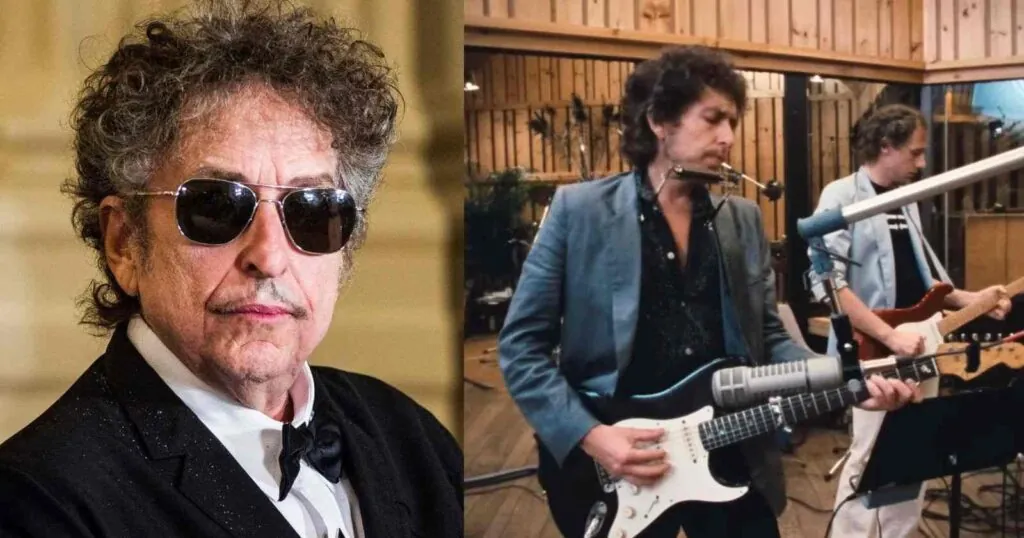
As one of the most prolific and acclaimed songwriters in history, Bob Dylan wrote songs that changed the course of music and popular culture. He was one of the artists who helped spark a revolution in the 1960s, showing musicians that they could write and sing about anything they wanted.
Although he spent decades focused on writing his own material and touring almost nonstop, he always remained aware of what was happening in the music scene. Throughout his career, Dylan praised many songs by other artists and singled out two that, in his opinion, rank among the most powerful of all time.
2 songs Bob Dylan said are among the most powerful of all time
Johnny Thunder “I’m Alive”
“I heard a record by Johnny Thunder. It’s called ‘I’m Alive’. Never heard it either, huh? Well, I can’t believe it. Everyone I’ve talked to, I’ve asked them if they’ve heard that record. I heard it on the radio a (few months ago). It was one of the most powerful records I’ve ever heard. It was that sentiment, truly expressed. That’s the most I can say, if you heard that record, you’d know what I mean. But that’s about all (at the Rock scene now),” Bob Dylan told Rolling Stone magazine in 1969.
Although the song was first recorded and made famous by the American R&B singer Johnny Thunder, it was actually written by Tommy James from the Shondells. Johnny’s version was released as a single in 1968, with the song “Verbal Expressions of T.V.” as the b-side.
Tommy James recorded the track with the Shondells in 1969, being featured on their groundbreaking album “Crimson & Clover”. It was also released as a single, but being the b-side for “Crystal Blue Persuasion”. Other famous songs by the band are “Crimson & Clover”, “I Think We’re Alone Now” and “Mony Mony”.
Besides “I’m Alive,” Johnny Thunder was also previously known for the 1963 song “Loop de Loop,” originally written by Teddy Vann and Joe Dong. However, he didn’t have any other major hits after the 1960s and passed away in 2024 at the age of 93. His real name was Gilbert Leroy Hamilton and he is often cited as one of the biggest American ‘one-hit wonder’ artists.
“Blues in the Night”
The second song is “Blues in The Night”, a popular Blues standard which was written by Harold Arlen back in 1941, being first recorded by Woody Herman and His Orchestra. “Harold Arlen had written ‘The Man That Got Away’ and the cosmic “Somewhere Over the Rainbow”, another song by Judy Garland. He had written a lot of other popular songs, too. The powerful ‘Blues in the Night,’ ‘Stormy Weather,’ “Come Rain or Come Shine,’ ‘Get Happy.’ In Harold’s songs, I could hear rural blues and folk music. There was an emotional kinship there. I couldn’t help but notice it. (..) “I could never escape from the bittersweet, lonely, intense world of Harold Arlen,” Bob Dylan said in his book Chronicles.
That track was written by Harold with lyrics made by Johnny Mercer. It was made for a 1941 film which had the working title of “Hot Nocturne” but the song was so good that they decided to rename it “Blues in the Night“. In the movie the song was sung by William Gillespie on the film. It ended up being one of the nine songs nominated for the Academy Award for Best Original Song. Over the decades the track was covered by artists like Shirley Bassey, Helen Shapiro and Rosemary Clooney. She was the mother of actor Miguel Ferrer and aunt of George Clooney.
He also was a prolific songwriter
Like Bob Dylan, Harold Arlen was also an extremely prolific songwriter, having written more than 500 songs during his career. He composed some of the most influential songs of all time, the biggest example is “Somwhere Over the Rainbow”. The track was featured on the groundbreaking movie “The Wizard of Oz” in 1939. With the succcess, became one of the biggest movie songs of the history of cinema.
He won the Oscar for the Best Original Song with that track and was nominated another 8 times. Arlen also wrote composed many songs for Broadway musicals from the 1930s to the 1950s. He passed away in 1986 at the age of 81, a victim of cancer at his Manhattan apartment.