

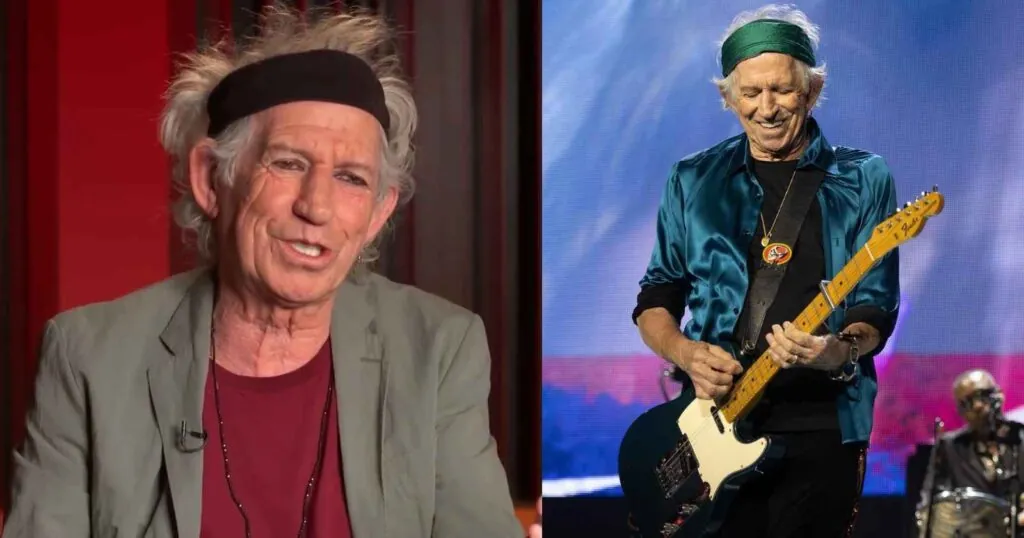
Keith Richards co-wrote some of the most important Rock and Roll songs in history and although he is often remembered as an incredible rhythm guitarist, he is also a quite underrated songwriter. His partnership with Mick Jagger was a crucial part of the Rolling Stones’ success and continues to inspire countless musicians around the world.
Unlike many artists from his generation, he remained interested in listening to new bands and has mentioned several of them over the years. Back in the 1980s, for example, when asked to list some of his favorite songs, Richards mentioned tracks by Dire Straits, Tina Turner, Max Romeo and Gregory Isaacs, while also naming some of the older artists he loved.
10 songs Keith Richards said were some of his favorites of all time
Otis Redding “Try a Little Tenderness”
“The first (one I’d like to play) is Otis Redding’s ‘Try a Little Tenderness.” After the track was played, the interviewer noticed that not a word was spoken in the studio while the song was playing because both of them really wanted to listen to the track. Keith then replied: “It’s true. Unfortunately I never did get a chance to meet him.”
“He was always working somewhere where we weren’t, you know. I always figured I had lots of time to see him. You don’t expect that sort of thing to happen,” Keith Richards mentioned the fact that Redding tragically died in a plane crash at the age of 26 in 1967. After being asked if he was one of the artists The Rolling Stones would have enjoyed working with, he said: “Oh yeah! That would have really put the cap on it, wouldn’t it,” Keith Richards said in an interview with BBC radio‘s “My Top 10” show in 1986 (Transcribed by Rock and Roll Garage).
Originally recorded by the Ray Noble Orchestra in 1932, “Try a Little Tenderness” was covered by Otis Redding in 1966. On his version, the late singer was backed by the legendary band Booker T. & the M.G.’s, along with Stax staff producer Isaac Hayes, who worked on the arrangement.
Dire Straits “Money for Nothing”
After picking “Money for Nothing” to be played, Keith was asked how highly he rated Mark Knopfler. He said: “Very high, very high. I love his sound, love the touch and I love the stuff he’s writing too these days. I’m very impressed with it and he is working with Bob (Dylan) for a while too. I think you got a lot out of that,” Keith Richards said.
In the previous year, Richards was a bit curious about Knopfler and during a recorded rehearsal before the Live Aid charity festival, he talked with Ronnie Wood and Bob Dylan about Dire Straits and their frontman. During the conversation, Wood asked: “Did you hear the new Mark Knopfler stuff? The new Dire Straits song about the microwave ovens and MTV (‘Money for Nothing’).”
Both said they had not heard it yet, and Keith replied: “All I know about Dire Straits is they are working in London and our truck is recording them. (…) I mean, it is good music. How is this Mark Knopfler? I have never met him, lovely guitar player,” he said. Dylan and Wood then responded that Knopfler is a quiet person. The Dire Straits hit was part of their fifth studio album “Brothers in Arms”, which is their best-selling one.
Tina Turner “What’s Love Got to Do with It”
“I was really glad to see her (coming back). I’ve worked with her for many years and she’s a real darling,” Keith Richards said. He has always been a huge fan of Tina Turner and he believed that, for a long time, regular music fans did not realize what a great singer she was.
“I think sometimes Tina’s persona blind a lot of other people (who are not) musicians to the fact (that she is a) great singer. In a way, for a while detracted and probably stopped (people from seeing that). It took quite a long time to actually hit it right in the middle 80s, before she really nailed her own thing down,” Keith Richards said in the early 90s.
“What’s Love Got to Do with It” was released in 1984 on Tina’s fifth studio album, “Private Dancer.” Written by Graham Lyle and Terry Britten, the track peaked at number one on the charts in several countries, including the United States.
Freddie Scott “Are You Lonely For me Baby”
“It’s true (that the Black American musicians influenced me), it’s what I was brought up on. It’s the stuff I learned to play, that’s what fired me up to say ‘I’ve got to learn how to do that. I’ve got to learn how to play like that,” Keith Richards said.
Richards has already mentioned that the song is one he wishes he had written. “I would have to go back to ‘Are You Lonely For Me Baby’. That to me is the most superb R&B, the epitome (of that kind of music). I’m trying (to do it), I’m going for it (laughs),” Keith Richards said when answering fans’ questions on his Youtube channel in 2016.
In the previous year the Rolling Stones guitarist had already listed that song in an interview with BBC, saying it was one of the records he would take to a desert island. The track “(It’s) probably the (most) classic Rhythm and Blues record of all time. It’s produced by Bert Berns, who also produced Van Morrison’s ‘Brown Eyed Girl’, great producer. Here (he is with) Freddie Scott, one of the greatest Soul singers. I hope you are going to enjoy this one,” he said.
The song remains Freddie Scott’s most successful release. It peaked at number one on the R&B chart for four weeks in 1967. Berns was one of the most influential songwriters of his generation, having written songs like “Twist and Shout”, “Piece of My Heart” and “Here Comes the Night.”
Max Romeo “War Ina Babylon”
“This music started for me when I was marooned in Jamaica. I lived on and off (there). It’s Max Romeo ‘War ina Babylon’. (After Bob Marley’s death) it would be fair to say that for most of the world, when Bob Marley died, Reggae music took a few steps down the ladder. Because he was so big. He was bigger almost than the music but of course, in its own area and wherever a few west indians are gathered, which is quite a few places.”
“It’s still going from strength to strength and I’ve always been fascinated by the way those guys record. Because they never had any what would be called as a formal recording training, they would just look at the machine and see what it could do. Someone here and in America would say ‘oh, you got to fade this down gently’. They would go ‘no, because you can do this’. I’ve always loved their open-minded approach to recording”.
“That’s what struck me when I got there. Because all I knew of Reggae really until I went to Jamaica was exactly the (kind of commercial) stuff. It was only when I got there that I started to listen to what was going on down on the island and realized there was a lot more to it. Soon after that, it was when Bob started to catch a fire,” Keith Richards said.
“War Ina Babylon” is the title track of Max Romeo’s 1976 studio album. The Jamaican singer and songwriter was one of the most prolific artists of his generation. He released more than 20 studio albums during his career.
Ronnie Wood “Crotch Music”
“I think his first band is called The Birds (the English band). The next I heard of him he was with The Faces. In fact, it was while he was making his first (solo) album. He gave me a call, I bumped into his wife in a club. She said: ‘Ronnie is recording down in his basement with a good great band and he always said: ‘If you see Keith tell him to come along'”.
“It was boring down the club and she gave me a lift down to Ronnie’s, which gives us a good one here, because the track they were working on, which I was ‘Crotch Music’,” Keith Richards said. Crotch Music” was part of Ronnie Wood’s debut solo album, “I’ve Got My Own Album to Do,” released in 1974.
The track was written by bassist Willie Weeks, who also performed on the record. Other special guests on the album included George Harrison, Keith Richards, and Mick Taylor. The backing vocals were provided by Mick Jagger, David Bowie, and Rod Stewart.
Erma Franklin “Piece of My Heart”
“(Janis Joplin) she did (a great version of the song). This was the original version,” Keith Richards said. Erma Franklin was an American Gospel and Soul singer who was the older sister of the legendary Aretha Franklin. As Richards noted, she was the first to record “Piece of My Heart,” written by Bert Berns and Jerry Ragovoy.
Released in 1967, her version peaked at number 10 on the Billboard Hot Rhythm & Blues Singles chart. She was nominated for a Grammy Award for the song that same year. But it was the following year that Janis Joplin’s version truly reached the mainstream and became a huge classic. Big Brother and the Holding Company, which was fronted by Joplin, released their version on their second studio album, “Cheap Thrills,” in 1968.
Jimmy Ruffin “What Becomes of the Brokenhearted”
Released as a single by the American singer Jimmy Ruffin in 1966, “What Becomes of the Brokenhearted” is one of Motown’s most frequently revived hits. It has been covered by several artists over the decades.
The song performed very well on the charts, peaking at number 7 on the US Billboard Hot 100. The track was written by William Weatherspoon, Paul Riser, and James Dean (not the actor). They originally intended to give the song to the Spinners, but Ruffin managed to convince them to let him record it instead. He was the older brother of the Temptations’ lead singer, David Ruffin.
Gregory Isaacs “If I Don’t Have You”
Gregory Isaacs was one of the most prolific Reggae musicians of all time, with more than 50 studio albums released during his career. “If I Don’t Have You” was part of his 1981 album “More Gregory”.
The musician was born in Kingston, Jamaica, in 1951. He began his career in 1968 and remained active until 2010, when he passed away at the age of 59. He died at his home in Harrow Weald, London, from complications of lung cancer. A memorial service was held later at Kingston’s National Indoor Sports Centre.
Little Walter “Key to the Highway”
“Key to the Highway” is a blues standard that has been covered by a large number of musicians over the decades. The legendary American blues singer and harmonica player Little Walter was the one who revived the song, updating it in 1958. The session featured some of the most famous artists of his generation, including Muddy Waters on slide guitar, Luther Tucker on guitar, Otis Spann on piano, and Willie Dixon on bass.
It became a major hit, spending 14 weeks on the Billboard R&B chart and peaking at number 6 in 1958. Walter sadly had a short life and career, as he passed away in 1968 at the age of 37. After taking a break from a performance at a nightclub on Chicago’s South Side, he became involved in a fight. Although he reportedly suffered only minor injuries, the altercation aggravated damage from previous fights. He died in his sleep shortly afterward.